

Calcium Sulfate Antistatic Floor Factory Producing High-Performance ESD Flooring Systems
2026-09-30
When static electricity threatens precision manufacturing and sensitive electronics, ordinary flooring quietly becomes a liability. That’s why our calcium sulfate antistatic floor factory exists: to engineer high-performance ESD flooring systems that don’t just meet cleanroom standards—they redefine them. Built around a naturally stable, non-combustible calcium sulfate core, every panel from Lipin Floor is engineered for rapid static dissipation, superior load bearing, and long-term dimensional stability. In the paragraphs ahead, you’ll discover why more facility managers are abandoning raised access floors that crack, warp, or leak charge—and turning to a smarter, quieter solution that was born to perform under pressure.
Why Calcium Sulfate Antistatic Flooring Works So Well in Electronics Manufacturing
In electronics manufacturing, static discharge is a silent killer of sensitive components. Calcium sulfate antistatic flooring addresses this by forming a continuous, low-resistance path that safely bleeds away built-up charges before they can reach a microchip or circuit board. The material's natural porosity and mineral composition allow it to hold a consistent electrical resistance across the entire surface, even in dry environments where static tends to accumulate faster.
Another reason this flooring stands out is its dimensional stability under heavy loads and temperature swings. Electronics facilities often move carts, racks, and automated equipment across the floor. Calcium sulfate panels resist warping and compression, which keeps the antistatic layer intact over years of use. Unlike thinner vinyl or epoxy coatings that can crack or peel at high-traffic junctions, calcium sulfate maintains a flat, seamless connection point where grounding strips or copper tape are installed.
Moisture also plays a key role. The gypsum-based core naturally regulates relative humidity near floor level, which helps keep antistatic properties consistent without relying on ambient humidity spikes. This self-regulating behavior means the floor performs reliably whether the production area is cooled by dry air conditioning or experiences brief humidity changes during shift changes. Installers also appreciate that the panels can be cut and fitted around cleanroom equipment without disrupting the static-dissipative network, reducing downtime during layout revisions.
Inside the Plant: How High-Performance ESD Flooring Systems Are Built
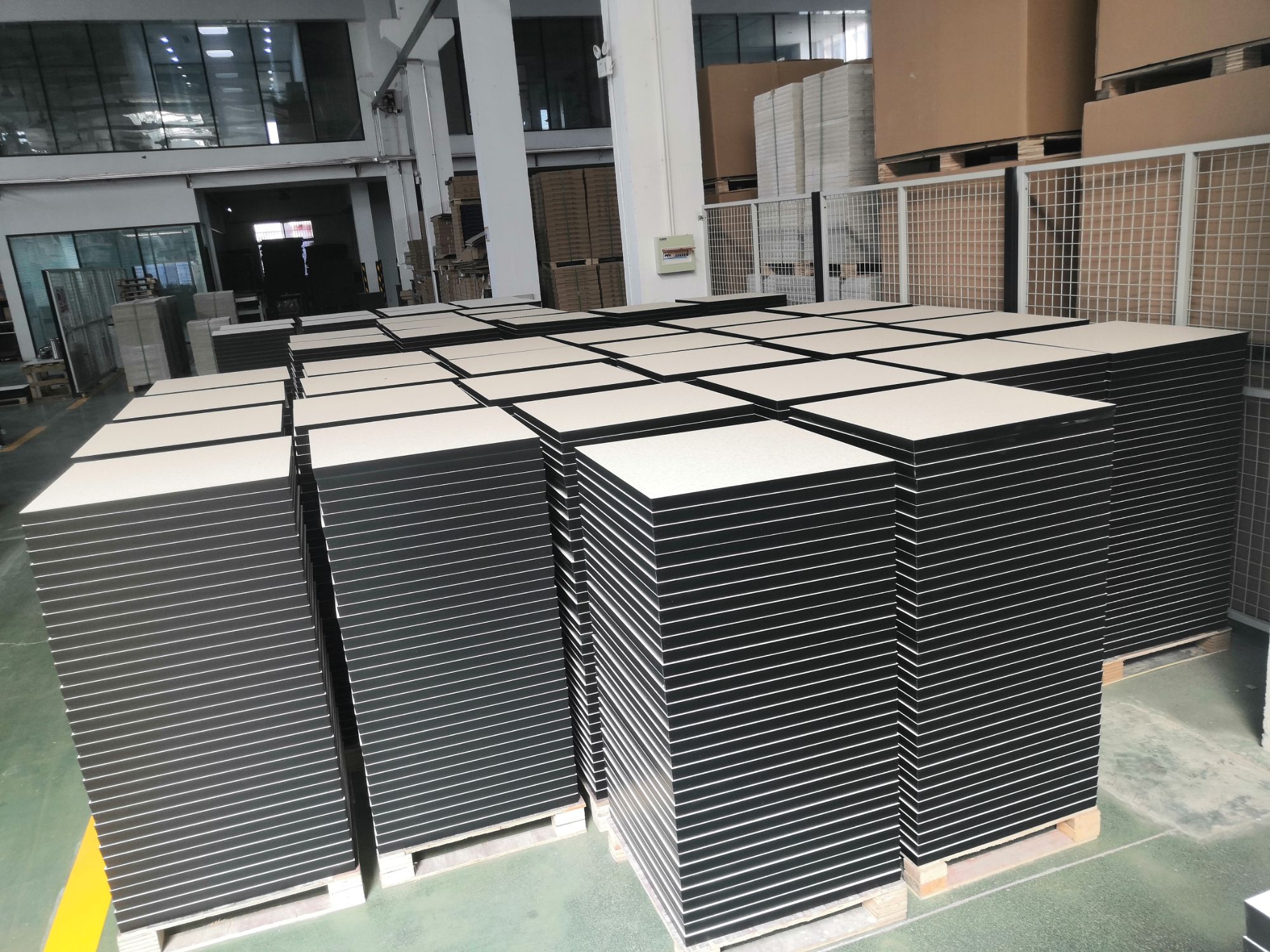
Stepping onto the production floor, the air carries a faint resin scent and the low hum of industrial mixers. Raw materials arrive in labeled silos—epoxy binders, conductive carbon fibers, and precisely graded silica aggregates. Workers in static-dissipative smocks weigh each batch on digital scales, then feed the components into high-shear blenders. The goal from the first pour is uniformity: every square meter must eventually bleed away static charge at the same controlled rate.
Once blended, the liquid compound moves to the application line. A primer coat seals the concrete substrate, followed by a continuous copper grounding grid laid in a diamond pattern. The conductive undercoat is then applied with notched squeegees, embedding the copper strips fully. Here, the plant’s climate control matters more than most outsiders realize—humidity above 55% can alter the cure time, so the line runs under tight hygrothermal monitoring.
The final stages are the most exacting. After the conductive layer sets, a self-leveling topcoat is poured and spike-rolled to release trapped air. Within hours, technicians press two brass electrodes into the surface and log the resistance reading; the sweet spot sits between 10^6 and 10^9 ohms. Panels that fall outside that window are either re-coated or stripped back to the copper grid. Only after a 72-hour cure and a second round of spot checks does the flooring earn its anti-static certification and roll out to the warehouse.
The Difference Between Static Dissipative and Conductive Flooring
When choosing flooring for environments where electrostatic discharge is a concern, many people assume static dissipative and conductive options are interchangeable. In practice, they serve distinct purposes based on how quickly they allow electrical charges to move across the surface. Static dissipative flooring is designed to slow down the flow of electricity, typically exhibiting a resistance range between 1 x 10^6 and 1 x 10^9 ohms. This controlled discharge protects sensitive electronics from sudden jolts while still preventing static buildup. Conductive flooring, on the other hand, has much lower resistance—usually under 1 x 10^6 ohms—meaning it can channel charges to ground almost instantly. That rapid conductivity makes it ideal for cleanrooms, explosive handling areas, and other settings where even a tiny spark could be dangerous.
The practical difference comes down to the speed and predictability of charge dissipation. A static dissipative floor acts like a resistor in a circuit, gently bleeding off static over a slightly longer period. This is often preferred in electronics assembly or server rooms where a sudden discharge could damage components even if it reaches ground. Conductive flooring behaves more like a direct wire to earth, providing a low-resistance path that minimizes any voltage difference across the surface. Because of this, you'll see conductive floors specified in hospital operating rooms, munitions facilities, or anywhere flammable vapors might be present. The choice isn't about one being better than the other; it's about matching the floor's electrical behavior to the specific risk profile of the space.
Another key distinction involves installation and maintenance. Static dissipative floors typically require conductive adhesives and grounding strips to work properly, and their performance can drift over time if waxes or finishes build up. Conductive systems demand even stricter grounding protocols, and any interruption in the copper grounding grid can render them ineffective. Both types need regular testing with a surface resistance meter, but the acceptable ranges differ significantly. Understanding these boundaries helps facility managers avoid the costly mistake of installing the wrong flooring for their ESD control program.
How Conductive Additives Give Calcium Sulfate Its Grounding Power
Plain calcium sulfate behaves like a stubborn insulator, trapping charge instead of letting it move. Adding conductive additives changes that picture at the microscopic level. Carbon black, graphite, and similar particles weave between the calcium sulfate crystals, forming a broken chain of conductive touchpoints. Once enough additive is present, those touchpoints link up into a continuous network, giving electrons a clear path to escape rather than building up on the surface.
The grounding performance depends less on the additive's own conductivity and more on how well it fills the gaps between insulating particles. A little too little and the network stays fragmented; a little more and the material shifts from static-prone to safely grounded. That threshold is where the real engineering happens, letting calcium sulfate hold its structural role while quietly channeling stray charge away.
Real-World Environments That Demand Reliable ESD Flooring
Walk into any electronics assembly line and you'll feel the tension before you see it—technicians in heel straps, humidity monitors humming, and every surface chosen for a reason. Static discharge here doesn't just ruin a batch of microchips; it can silently compromise components that pass initial tests but fail weeks later in the field. That's why the flooring beneath those workbenches isn't waxed concrete or standard tile. It's a carefully engineered path to ground, one that bleeds away charge before it ever reaches a sensitive board.
The same demand shows up in less obvious places. Hospital operating rooms handling flammable anesthetics rely on static-dissipative floors to prevent a spark that could ignite gases. Server rooms and data centers, with rows of humming racks, need flooring that won't let a technician's shuffling feet build up a zap that fries a switch port. Even aerospace cleanrooms, where a single stray charge can alter sensitive instruments, depend on floors that meet strict resistivity ranges—not too conductive, not too insulating.
What ties these spaces together is the cost of failure. A single static event in a munitions storage area or a pharmaceutical powder-handling room can trigger an explosion or contaminate an entire batch. Reliable ESD flooring isn't a luxury add-on; it's the quiet baseline that keeps production lines moving, patients safe, and data flowing. When the environment demands certainty, the floor is the first line of defense.
What Factory Testing Reveals About Long-Term Antistatic Performance
Factory testing cuts through marketing claims by stressing antistatic materials under conditions that mimic years of wear in a matter of weeks. Standard checks for surface resistivity and static decay time are useful, but long-term performance hinges on how well a material holds up after repeated abrasion, humidity swings, and contact with oils or solvents. A floor tile that passes initial specs can lose its conductive path once the surface layer wears down, so accelerated abrasion tests paired with periodic resistivity measurements give a far more honest picture.
Thermal cycling and elevated humidity exposure reveal whether antistatic additives bloom to the surface or leach out entirely. Some polymer blends rely on migratory agents that work fine at room temperature but fail after repeated heating and cooling, leaving dead spots where charge builds up unnoticed. Factories that log resistivity across multiple points on the same sample after each aging cycle catch these uneven failures early, something a single-point lab test would miss.
The most revealing tests combine mechanical stress with electrostatic measurements in sequence. A workbench laminate might be flexed, scratched with a standardized tool, then wiped with common cleaning agents before surface resistance is measured again. If the reading stays within the desired range through several such cycles, it is a strong signal the material will not become a hidden ESD hazard six months into production. Factory data collected this way gives engineers confidence that goes well beyond a certificate of conformity.
FAQ
It's a raised access floor panel built around a calcium sulfate core, topped with a conductive surface layer that safely dissipates static electricity. The core provides strong dimensional stability and fire resistance, while the antistatic treatment keeps sensitive electronics protected.
Every batch goes through strict conductivity testing and load-bearing checks before leaving the line. Raw materials come from certified suppliers, and the curing process is tightly controlled so each panel hits the same electrical resistance range and mechanical strength.
You'll mainly find them in data centers, cleanrooms, electronics assembly areas, server rooms, and laboratories—anywhere a random static discharge could damage components or disrupt equipment.
Calcium sulfate panels are heavier and denser than chipboard, which gives them a solid, quiet feel underfoot. They also resist moisture better than wood and avoid the metallic resonance or higher cost of steel, making them a practical middle ground for controlled environments.
Yes. Panel thickness, surface finish, and the conductive vinyl or laminate layer can be adjusted. For heavier equipment, reinforced edges or additional supports can be specified, and the resistance range can be tuned to match the specific ESD standard your facility needs.
Use a damp mop with a neutral pH cleaner and avoid waxes or oil-based polishes, which can create an insulating layer. Regular checks of the grounding connections and occasional resistance testing will keep the system performing as intended.
Once the subfloor is leveled, adjustable steel pedestals are laid out on a grid, and the panels are placed on top. Each panel is connected to a grounding grid, and the finished floor height can be set to accommodate underfloor cabling or air distribution.
We can handle projects of nearly any size, from single control rooms to multi-floor data centers. The engineering team reviews layout drawings, advises on load distribution and air flow, and can coordinate delivery to match tight construction schedules.
Conclusion
Calcium sulfate antistatic flooring has become a preferred choice in electronics manufacturing because it combines a dense, dimensionally stable core with controlled electrical properties that prevent sudden electrostatic discharge. Unlike ordinary vinyl or epoxy coatings that rely solely on surface treatments, these panels distribute conductive additives throughout the entire board, so grounding performance remains consistent even after years of foot traffic and equipment movement. In production areas where static-sensitive components are handled, the floor must fall within a specific resistance range—often between 10^6 and 10^9 ohms for dissipative applications or below 10^6 ohms for conductive settings. Factory engineers adjust the ratio of carbon fiber, graphite, or metallic fibers during mixing to hit the target for each project, ensuring the installed system meets both safety and operational requirements.
Inside the manufacturing plant, the process involves pressing calcium sulfate slurry into high-density panels, then bonding them to a conductive underlayment or copper grounding grid. This construction creates a reliable path for static charges to bleed off harmlessly instead of building up on workers or sensitive machinery. The resulting floors are found in semiconductor fabrication plants, aerospace assembly rooms, data centers, and pharmaceutical cleanrooms where even a small spark can ruin products or trigger safety hazards. To verify long-term antistatic performance, the factory performs accelerated wear tests, humidity cycling, and point-to-point resistance measurements across the finished surface. These test results help customers understand how the floor will perform not just on day one but after years of rolling loads, chemical spills, and repeated cleaning—turning a simple building material into a critical part of an ESD control strategy.
Contact Us
Contact Person: yuki
Email: [email protected]
Tel/WhatsApp: +86 18664390732
Website: https://www.lipinfloor.com/