

China Shock Absorber Boots and the Key Factors for Choosing Reliable Suspension Parts
2026-11-17
Most suspension failures don't start with a bang—they start with a cracked rubber boot letting dirt eat a shock absorber from the inside. If you're sourcing shock absorber boots from China, the difference between a part that lasts and one that fails early often comes down to details most buyers never inspect. That's where XIAYI takes a different approach. In this guide, we break down the material, fitment, and quality signals that separate dependable suspension parts from costly compromises.
The Boot Usually Fails Before the Shock Does
The rubber boot around a shock absorber tends to crack and split long before the shock itself stops damping properly. Once that thin cover tears, sand, salt, and moisture get a direct route to the piston rod and the upper seal. It looks like a minor part, but it handles most of the daily abuse.
A torn boot rarely causes immediate failure. Instead, dirt works its way past the seal little by little, scoring the rod and wearing down the internal valving. By the time you notice a bouncy ride or a light film of oil around the strut, the damage has already moved well beyond a simple dust cover replacement.
Checking the boots whenever the wheels are off for a brake job or tire rotation is usually enough to catch them early. Cracked or split rubber should be replaced right away. It is one of the cheapest suspension parts you can buy, yet it often prevents the much larger expense of replacing the entire shock assembly.
Rubber Compound Clues That Surface Only After Disassembly
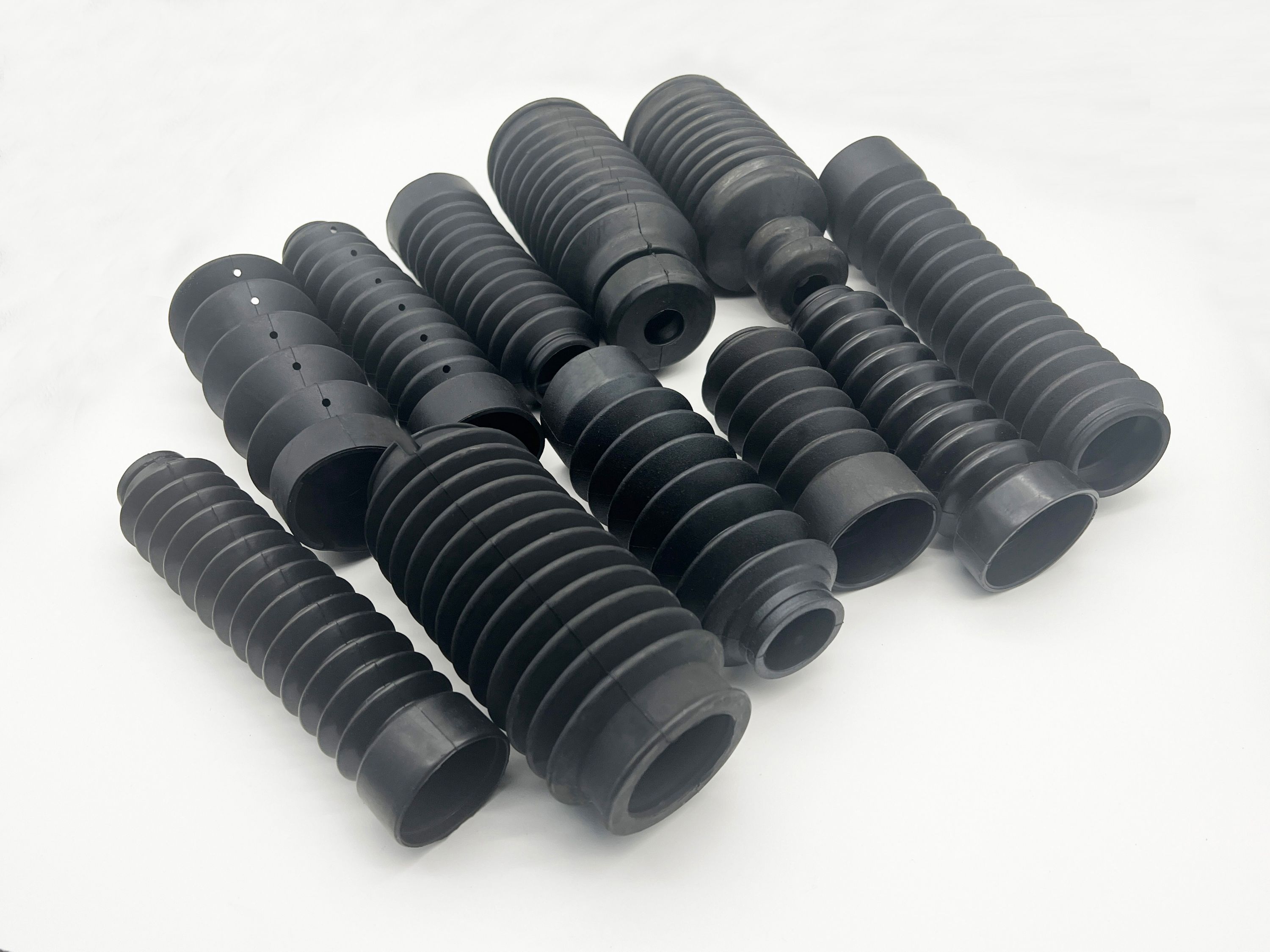
A compound that feels perfectly sound on the outside can tell a different story once the part is pulled from its housing. The first hints often appear at cut surfaces or bonded edges: a grainy fracture instead of a clean tear, a dull patch where the cure was starved of heat, or a slight tack that never made it to the surface. These are not manufacturing flaws you can see on a datasheet; they only show up when the cross-section is exposed and the internal cure state is finally readable.
Seals and gaskets offer another layer of evidence after removal. The side that faced the fluid may look intact while the backside reveals plasticizer bleed, a chalky bloom, or shrinkage cracks that formed as the low-molecular-weight fractions left the compound. In some cases, a lip that was compressed in service will hold its deformed shape after disassembly, pointing to a permanent set problem tied to crosslink density rather than a simple hardness issue.
Thermal damage also hides until the rubber is flexed or cut. A hose that appeared uniformly black on the vehicle can show a brittle inner liner, fine circumferential splits, or a distinct color change just beneath the outer cover. Bending a removed bushing at room temperature may open micro-cracks that were invisible under installed stress, and the smell of degraded antioxidant or the feel of a powdery surface can confirm that the formulation ran out of protection long before the part leaked.
Why a Factory Address in China Is Not a Quality Signal
A Chinese factory address often gets treated like a badge of legitimacy, but the location itself reveals very little about how a product is actually built. The same industrial park can contain one workshop that exports to demanding European brands and another that cuts corners on raw materials, tolerances, and final inspection. Without seeing the production line, the sourcing records, or the rejection rate, the street name on an invoice is just geography.
Quality comes from process control, not postal codes. A capable factory in Shenzhen can produce excellent goods, while a less disciplined facility across the road can ship inconsistent batches under a similar address. The real signals include whether the supplier uses calibrated equipment, maintains clean assembly areas, performs incoming material checks, and keeps traceable records for each order. Those details are not visible in a company profile or a warehouse photograph.
Buyers who rely on the address as a shortcut often skip the harder verification work that actually prevents expensive mistakes. It is more useful to ask for a recent third-party audit, request samples from current production rather than a pre-made batch, and test whether the factory can explain how it handles defects. A street in Guangdong or Zhejiang may suggest manufacturing density, but it never substitutes for evidence.
Small Fitment Errors That Turn Into Persistent Cabin Noise
A door panel that snaps in with just enough resistance can still leave a tab half a millimeter off its seat. That gap rarely shows under a flashlight, but at highway speed it turns into a faint tick that comes and goes with every expansion joint.
The real problem is that cabin trim acts like a stethoscope. A loose clip buried behind the B-pillar doesn't just rattle on its own; it sends vibration straight into the plastic shell, where the sound gets amplified and pushed toward the driver's ear. Even a wiring harness that rubs against a metal bracket because the retaining hole was drilled a few degrees off will make itself known as a soft, rhythmic squeak.
What makes these noises hard to chase down is that the parts look seated until the vehicle moves. Heat, body flex, and repeated loading slowly work the misaligned component until it finds a new rest position. Once that happens, the noise becomes steady enough to feel permanent, even though the original cause may be no more than a clip that was forced instead of fitted.
The Kind of Testing Data Worth Requesting
Most teams ask for clean, representative samples and then wonder why production still surprises them. The data actually worth requesting is the messy stuff: interrupted sessions, out-of-order events, duplicated records, and values that sit just outside the expected range. It is far easier to fix a parser when you have seen a date like February 30th than to debate whether it can happen.
It also helps to request data tied to a specific timing or sequence, not just a flat spreadsheet. Real systems rarely deliver messages in the order the documentation promises. Asking for timestamps, retry markers, and partial payloads gives you something closer to what the code will actually meet. That kind of data turns a vague concern about edge cases into a repeatable test.
Context matters more than volume. The best test data carries a little background: which user, which device, which version, and what happened just before. Without that, a failing record is only a puzzle. With it, you can trace the failure back to a decision someone made. Request that context early, because trying to reconstruct it after the fact is slow and unreliable.
How to Tell a Suspension Specialist From a General Trader
A suspension specialist usually asks about your vehicle's weight, ride height, and how you actually use it before recommending anything. A general trader tends to start with a part number or a price. That difference matters because suspension components rarely work well in isolation — spring rates, damping curves, and bushing compliance all interact with each other. The specialist knows this and will push back if your initial choice doesn't match your stated goals, whereas the trader will happily sell you whatever you ask for.
Another clue is the kind of detail that comes up during conversation. A specialist can explain why a monotube damper behaves differently on rough pavement compared to a twin-tube, or how a small change in offset affects scrub radius and steering feel. A general trader typically sticks to catalog descriptions, fitment lists, and shipping times. Neither approach is wrong for every situation, but if you're chasing a specific handling characteristic, the depth of the specialist's questions is a better indicator than the size of their inventory.
The follow-up support after a sale is often the clearest divider. Specialists tend to offer guidance on preload, alignment settings, or break-in procedures without being asked twice. General traders may direct you to a PDF or suggest contacting the manufacturer. If you value having someone who understands why a car understeers on corner entry and can suggest a damper or sway bar adjustment, look for the person who treats your suspension as a system rather than a list of individual parts.
FAQ
They keep dirt, moisture, and road debris away from the piston rod and seal, which helps prevent premature wear and leaks. A split or missing boot often leads to scratched rods and seal failure long before the damper itself wears out.
Many Chinese manufacturers have upgraded their compounding and molding processes, so you can find boots made from chloroprene or EPDM with consistent wall thickness at a much lower cost. The key is not the country of origin but whether the factory can document material specs and tolerances.
Chloroprene and EPDM usually outperform generic rubber because they resist ozone cracking, salt spray, and temperature swings. Ask for a material datasheet rather than relying on terms like heavy duty or premium rubber.
Look for clear dimensional drawings, batch-level hardness testing, and real-world references from buyers with similar operating conditions. If a supplier avoids sharing test reports or cannot explain how they control shrinkage, that is a warning sign.
Price matters, but not as a standalone metric. An extremely cheap boot can fail in one winter if the compound is wrong, while a mid-priced option with proper UV stabilizers and tear resistance often ends up costing less per mile.
Yes. Check for uneven parting lines, overly glossy or brittle surface finish, strong chemical smell, inconsistent flexibility around the bellows, and missing markings for material or batch codes. These often indicate poor curing or recycled filler content.
Bump stops, strut mounts, and dust covers should be assessed together because a failing mount can load the damper rod unevenly and tear a new boot. Ask the supplier whether these parts are designed as a system rather than copied as separate pieces.
Conclusion
The boot usually gives out long before the shock body shows any real wear. A split or collapsed dust boot lets grit and water reach the rod seal, and once that seal is scored, oil seepage and damping fade follow quickly. Unfortunately, the rubber compound tells its story only after the old boot is pulled apart. Some boots turn brittle and snap with low elongation, pointing to heavy filler loading or poor curing, while others keep a waxy surface bloom and still flex after years of heat and ozone exposure. A factory address in China is not by itself a quality signal, because many labels come from trading offices or shared plants with little control over mixing and molding. The useful evidence is tied to tooling records, batch consistency, and whether the supplier actually owns the compounding process.
Small fitment errors rarely stay small. A boot neck that is slightly loose lets fine dust in, while one that is overstretched tears early. A bump stop that does not match the piston stroke can create persistent cabin noise that drivers mistake for loose trim or a failing mount. Worth requesting testing data that goes beyond dimensions: ozone resistance, heat aging, elongation at break, cold flex, and salt spray results for metal parts. A suspension specialist can discuss durometer, lip interference, and clamp retention, and will ask about ride height, load, and climate before recommending a part. A general trader mainly quotes price and lead time. That difference shows up later in whether the replacement lasts one season or several.
Contact Us
Contact Person: Leela
Email: [email protected]
Tel/WhatsApp: 8613586885132
Website: https://www.xiayishockparts.com