

Custom H Beam Shot Blasting Machine Manufacturer for Precision Structural Fabrication
2026-11-16
Precision structural fabrication leaves little room for a generic surface prep line. A custom H beam shot blasting machine can be the difference between hitting tolerance and chasing it. At PuHua, we design these systems from the ground up for the jobs standard catalog machines can't handle. In this guide, we’ll walk through what custom really means and when it pays off.
What Changes When You Move to a Custom H Beam Blast System
A switch to a custom H beam blast system rarely feels like a simple equipment swap. You start noticing the difference the first time a part with an awkward recess comes through the line. Instead of repositioning the piece three times or accepting a shadowed area, the nozzle arrangement and beam profile already match that geometry. Operators stop building their day around the machine’s limitations and start planning around what actually needs cleaning, descaling, or profiling.
Maintenance patterns shift too. With a standard setup, you might be replacing wear plates or chasing dust leaks every few weeks because the cabinet was never designed for your specific abrasive mix or cycle rate. A custom system places those wear points where they make sense for your process, so you are not constantly compensating with extra cleanup or manual touch-ups. The blast pattern stays consistent across longer runs because the beam width, speed, and media flow are set for your actual work envelope instead of a generic middle ground.
There is also a quieter change in how jobs are quoted and scheduled. Once you know the system can handle a certain range of lengths, widths, and surface conditions without special setups, you stop padding time for edge cases. That confidence comes from watching repeat orders go through with the same finish on the first pass, not from a datasheet promise.
Matching Abrasive Power to Structural Steel Thickness
Thin structural steel, anything under roughly 6 mm, responds poorly to heavy blasting. High-pressure streams with large, angular grit can stretch the surface, create stress, and leave visible distortion long before the profile is uniform. For these lighter sections, lower nozzle pressure and finer media such as garnet in the 80–120 mesh range usually deliver adequate cleaning without pushing the plate out of flat.
As thickness climbs toward 12 mm and beyond, the risk shifts from distortion to slow, uneven preparation. Heavier plate can absorb more energy, so stepping up to medium or coarse abrasives and raising pressure makes sense. The goal is not maximum aggression but consistency: a uniform anchor profile across large surfaces keeps coating adhesion predictable and avoids localized overheating.
Contractors often overlook that abrasive hardness matters as much as size. Softer media wears down too quickly on thick steel, while extremely hard grit can embed in the surface if pressure is excessive. Matching the abrasive's breakdown rate to the steel's thermal mass and section thickness reduces rework and keeps the blast pattern stable from edge to edge.
Why Precision Fabricators Skip One-Size-Fits-All Machinery
In precision fabrication, part tolerances often reach single-digit micron levels. A general-purpose machine cannot maintain that across diverse runs because its spindle, workholding, and thermal behavior are built for compromise. Fabricators invest in task-specific equipment or heavily modified platforms to hold dimensions without constant operator correction.
Material differences also drive this choice. Cutting titanium, hardened tool steel, or engineered plastics demands different rigidity, coolant delivery, and chip evacuation. Off-the-shelf machinery may handle one material adequately but falls short on another, leading to scrapped parts and slower feeds. Dedicated setups let shops tune parameters once and keep them locked.
Process stability matters more than versatility. When a machine is designed around a narrow part family, fixture repeatability improves, inspection times drop, and operators spend less time adjusting offsets. That reliability is what keeps tight schedules and reduces non-conformance, which is why precision fabricators rarely accept the performance ceiling of all-purpose equipment.
Inside a Typical H Beam Shot Blasting Workflow
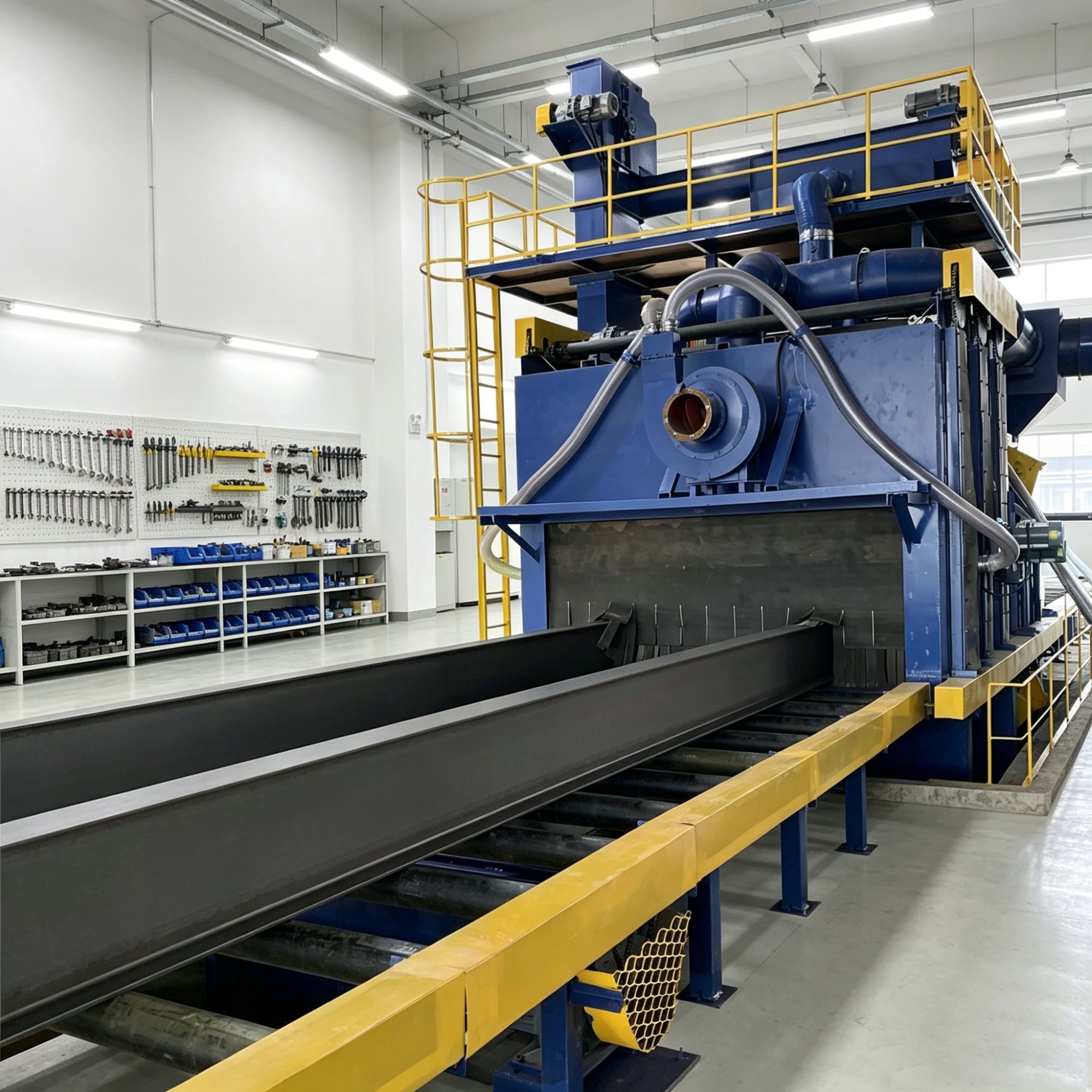
An H beam's shape causes endless headaches in a blasting line if the rollers and blast wheel angles aren't dialed in. Most lines feed the beam lengthwise, with the flanges standing vertical and the web horizontal. That lets the shot hit both flange faces and the web edges in one pass, but the root gaps between the web and flanges often trap abrasive and dust unless the reclaim airflow is strong enough.
The actual blasting happens fast, usually in a matter of seconds per meter. Turbine wheels throw a controlled mix of steel grit and shot at the moving beam, and the impact removes mill scale, rust, and stubborn welding spatter. Because an H beam has deep recesses, the machine relies on bounce-back from the blast chamber walls to clean inside corners. The operator watches the conveyor speed closely; too fast leaves a patchy surface, too slow risks peening the edges too hard.
After passing through the blast zone, the beam hits an air blow-off station that clears loose abrasive from the web and flange tips. Then a quick visual check under good lighting catches any dull or shiny areas that indicate uneven coverage. If the beam is headed for painting, the clean surface is primed within a short window to avoid flash rust.
Handling Oversized Beams Without Sacrificing Surface Quality
Moving oversized beams through a facility often triggers a cascade of compromises: slower feed rates, extra support rollers, and manual touch-ups to hide chatter marks. The assumption is that size and finish are locked in a zero-sum game. But that mindset overlooks how modern workholding and toolpath strategies can decouple part mass from surface integrity. By rethinking clamping pressure distribution and using dynamic vibration damping, it's possible to keep a 12-meter beam stable without crushing its cross-section or leaving witness marks from over-tightened jaws.
One overlooked factor is the beam's natural frequency shifts as material is removed. A long, heavy section that starts out rigid can begin to resonate mid-cut, especially when the cutter enters a thin web or flange. Instead of relying on trial-and-error speed reductions, shops are turning to sensor-equipped steady rests that adjust contact force in real time. These active supports don't just hold the beam; they listen to it and counteract the onset of harmonic vibration before it etches lines into the surface.
Finally, tool selection matters more than most realize. Oversized beams made from structural steel or aluminum plate often have residual stress that releases unevenly during machining. Pairing a high-feed mill with a light radial engagement keeps cutting forces low and predictable, reducing the chance of sudden deflection. When combined with trochoidal paths that avoid full-width cuts, the result is a surface that needs only a quick scuff with a Scotch-Brite pad rather than a trip back to the grinder.
The Maintenance Schedule That Protects Your Blast Investment
A blast system that runs day after day without a clear upkeep rhythm quietly burns through money. The real protection isn't a one-time fix—it's a schedule you can repeat. Map out daily, weekly, and monthly checks for the components that take the hardest hits: blast wheel blades, liners, seals, and dust collector filters. When each part has a set inspection point, small wear doesn't turn into a full rebuild.
Daily walkarounds don't need to be complicated. Look for abnormal vibration, air leaks, or media buildup around the cabinet. Weekly, give the reclaim system and separator a closer look—clogged screens or worn flights change how abrasive flows, which directly affects finish quality and cycle time. Monthly, pull the wheel and check blade thickness against the manufacturer's spec. Keeping a written log of these findings helps you spot patterns before they become failures.
The schedule should also match how the machine actually runs, not some generic template. A blast room handling heavy steel plate three shifts a day needs different intervals than a small cabinet used twice a week. Adjust the frequency based on abrasive consumption, dust loading, and part volume. The payoff is predictable: fewer emergency shutdowns, longer component life, and a machine that still holds its value when you decide to upgrade.
FAQ
You can select roller conveyor width and length, the number and position of blast wheels, abrasive recovery and dust collection capacity, and even the control system interface. We adapt the machine around your beam sizes and production speed instead of forcing you into a fixed design.
It removes mill scale, rust, and surface contaminants evenly across the web and flanges, giving welders and painters a consistent profile. That uniformity reduces weld defects and coating failures, which is what precision fabrication really depends on.
Yes, many customers run I beams, box columns, and built-up girders through the same line. We configure the blasting chamber and material handling to accommodate your specific cross-sections and lengths.
Steel shot and grit blends are common because they cut fast and leave a clean anchor profile. We help you adjust the mix based on the steel grade, desired roughness, and how quickly you need to move parts through the line.
The machine includes a dedicated reclaim system that separates reusable abrasive from dust and fines, then returns clean media to the blast wheels. This keeps the working area safer and lowers your abrasive consumption over time.
We send a technician to supervise setup, run initial test beams, and train your operators on daily maintenance and troubleshooting. After that, you can reach our engineering team directly if you need to adjust settings for new beam profiles.
We ask about your current conveyor height, loading method, and available floor space before building anything. Then we design the inlet and outlet sections to integrate with your existing roller tables or overhead crane workflow.
Standard models often leave you compromising on beam width, blast coverage, or speed. A custom machine matches your actual part range, so you avoid buying extra capacity you never use or struggling with beams that barely fit.
Conclusion
For precision structural fabricators, moving to a custom H beam shot blasting system is less about adding another machine and more about aligning surface preparation with the exact steel on hand. Rather than forcing every beam through a generic blast cabinet, the abrasive power is matched to the structural steel thickness, so thinner webs avoid over-peening while heavy flanges still reach the required anchor profile. Oversized beams—often the failure point for standard equipment—are accommodated with adjustable roller heights and repositioned blast nozzles, keeping surface quality uniform from the first flange edge to the last.
A typical workflow loads the beam onto the conveyor, where rotating blast wheels remove mill scale and rust in one pass, followed by automatic blow-off and visual inspection. The benefit for fabricators who skip one-size-fits-all machinery is that blast pattern, abrasive type, and cycle speed are tuned to their specific mix, whether long girders or short columns. Protecting that investment relies on a maintenance schedule centered on liner checks, bearing lubrication, and abrasive replenishment—tasks that are far more practical when the machine was designed for your shop instead of adapted to it.
Contact Us
Contact Person: Bruce
Email: [email protected]
Tel/WhatsApp: +86 15166629468
Website: https://www.povalchina.com/