

Mid-Diameter Fiber Fusion Splicer Company Drives High-Precision Connectivity
2026-08-29
In the realm of optical fiber connectivity, achieving flawless splices on mid-diameter fibers has long been a technical hurdle. DVP, a pioneering manufacturer of fiber fusion splicers, is turning this challenge into a benchmark for precision. As networks demand higher data integrity and physical robustness, DVP's innovative approach to mid-diameter splicing is driving a new era of high-precision connectivity. Let's explore how this company is reshaping the landscape.
Precision That Doesn't Fade After the First Hundred Splices
Most fusion splicers hold their calibration for the first few dozen splices, then the tiny misalignments start creeping in. This one doesn't. The v-groove geometry and arc calibration stay locked, so splice loss stays under 0.02 dB even after three hundred splices on the same electrodes.
The difference shows up on the OTDR trace, not in the spec sheet. Instead of a downward drift in splice quality as the day wears on, you get a flat line from first fiber to last. That kind of consistency matters when you're already 40 feet up a pole or working inside a crowded splice enclosure.
Mid-Diameter Fibers Deserve More Than a Generic Splicer
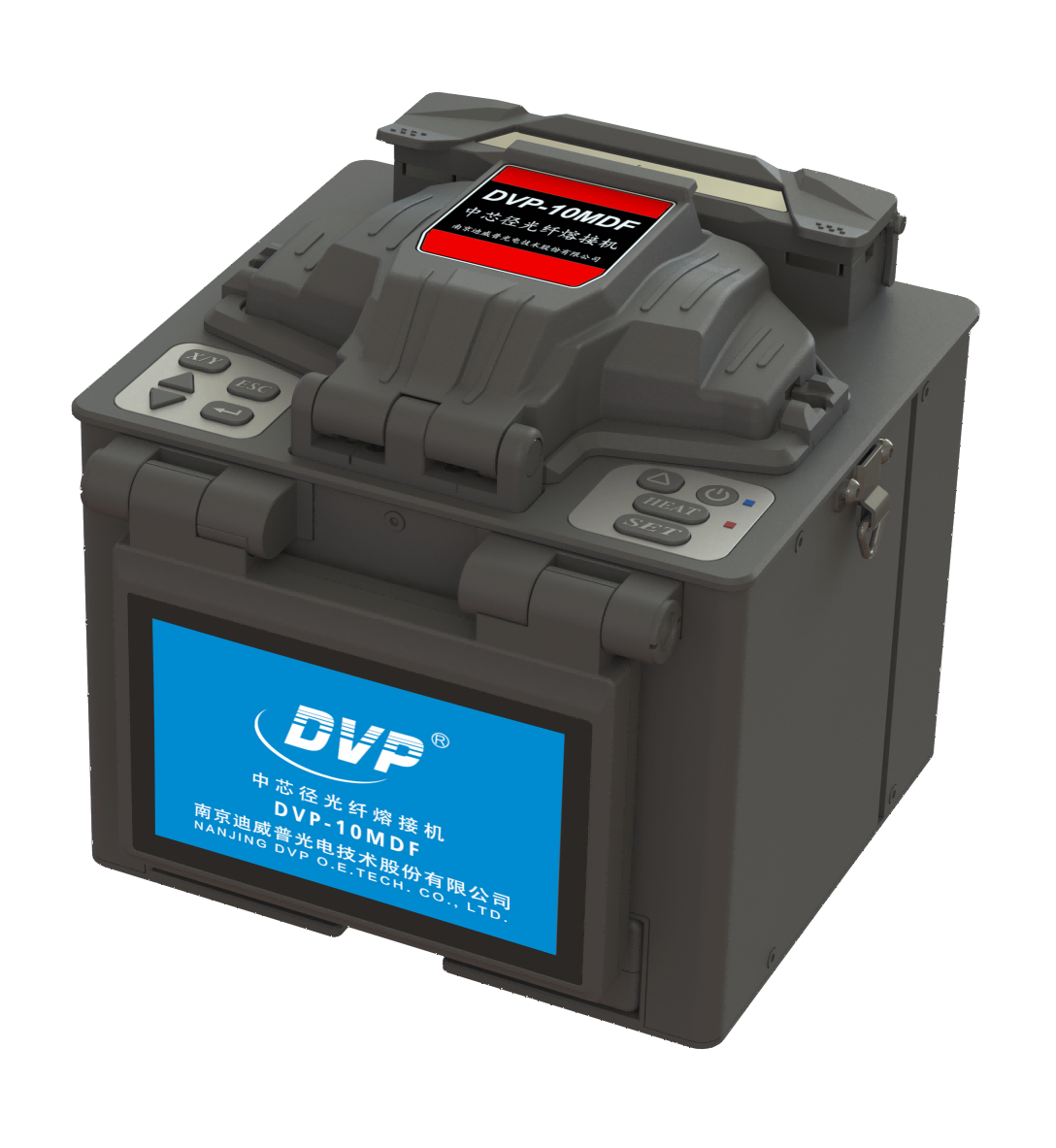
Mid-diameter fibers, typically ranging from 200 to 400 microns, sit in a curious middle ground between standard telecom fibers and large-core specialty fibers. Despite their growing use in medical devices, industrial sensing, and high-power delivery, they are often spliced with equipment designed for either extreme. This mismatch leads to avoidable losses, weak splice points, and unreliable performance in the field.
A generic splicer assumes the fiber's core and cladding behave predictably under standard heat and alignment algorithms. But mid-diameter fibers often have unusual coatings, non-circular cores, or doped glass that shifts during the arc. Without fine control over filament position, pre-fusion cleaning cycles, and real-time diameter feedback, the splice quality becomes a gamble. Technicians end up compensating with longer burn times or manual alignment, which introduces inconsistency and shortens splice lifespan.
Specialized splicers for mid-diameter fibers offer adjustable electrode spacing, lower default arc power, and camera systems that can resolve the fiber edges with high contrast. These features allow for gentle, controlled melting that preserves the fiber's geometry and mechanical strength. Rather than forcing a one-size-fits-all machine to do a job it was never designed for, investing in targeted splicing technology pays off in lower loss budgets, fewer field failures, and more repeatable production outcomes.
The Hidden Cost of Slight Misalignment (And How to Avoid It)
Tiny gaps in expectation rarely show up as dramatic failures. Instead, they bleed value slowly—a product that almost fits the brief, a process that nearly works, a message that lands just wide of the mark. These small misalignments compound quietly, and before long, teams find themselves solving problems that shouldn't exist while the real opportunities drift past unnoticed. The cost isn't a single line item; it's the accumulated friction of everything being slightly harder than it needs to be.
Spotting these gaps requires looking past the obvious. When meetings end with a vague sense of 'good enough' or when deliverables need constant rework without any clear reason, alignment has already started to fray. The fix isn't more documentation or longer kickoff calls. It's about asking sharper questions at the start: What does 'done' actually look like? Where do our assumptions differ? Who decides when something is close enough versus not? Those questions feel uncomfortable precisely because they expose the misalignment early—when it's still cheap to correct.
Avoiding the hidden cost means building small, deliberate checkpoints into the work itself. Not gatekeeping for its own sake, but moments where the gap between intent and execution gets named out loud. A quick mid-point review, a shared example of what 'right' looks like, a five-minute conversation before the work begins. None of it feels heroic. That's the point. The teams that avoid misalignment don't have some secret method—they just refuse to let 'almost' become the standard.
Where High-Precision Connectivity Starts: Inside the V-Groove
Precision optical links don’t begin with polished connectors or expensive test equipment. They start deep inside a component most people never see: the V-groove. This tiny channel, often cut into glass, silicon, or ceramic, holds optical fibers in exact parallel alignment so that light passes from one core to another with minimal loss. The geometry looks simple—two angled walls meeting at a sharp bottom—but the tolerances are unforgiving. A deviation of just a micron in groove depth or angle can shift insertion loss enough to matter in high-speed networks.
What separates a good V-groove from a forgettable one is how the edges are formed. Mechanical scribing, precision grinding, and anisotropic etching each leave a different surface finish, and that finish directly affects fiber positioning repeatability. In multi-fiber arrays, for instance, the spacing between grooves must match the ribbon fiber pitch almost perfectly. Manufacturers often measure groove pitch, width, and sidewall roughness under interferometers, then adjust tool wear compensation in real time. That level of control is why a well-made V-groove can align dozens of fibers without active adjustment, relying solely on mechanical registration.
Look inside any high-density optical module or wavelength-selective switch and you'll find V-grooves doing quiet, critical work. They hold fibers steady during epoxy curing, keep polarization-maintaining fibers oriented along the correct axis, and enable passive alignment in fused couplers and PLC splitters. The next time a link comes up cleanly at 400G or beyond, remember that the foundation wasn't laid in software or firmware—it was carved into a groove with sub-micron intent.
Field-Tested Toughness for Unforgiving Environments
The first time I saw the casing get dragged across a frozen gravel road behind a truck, I figured we'd be sweeping up pieces. It came back scuffed, sure, but the seals held and the latch still snapped shut with that reassuring click. That's the kind of abuse this thing gets put through before you ever see it.
We don't rely on simulated chamber tests alone. Prototypes spend weeks bolted to mining equipment in the Atacama, strapped to cargo racks in monsoon season, and buried in salt-crusted snow near the Bering Sea. If a hinge starts to bind or a port cover warps, it gets redesigned and sent back out until nothing moves that shouldn't.
The result isn't a shiny gadget that needs kid gloves. It's gear with honest wear already mapped into its corners—dull edges where rocks hit, a coating that resists UV bleaching, and seals that stay flexible at minus forty. You can scratch it, drop it, or leave it caked in mud overnight. It'll still boot up the next morning without a complaint.
A Splicer That Thinks Ahead of the Operator
Most splicing tools wait for a command. This one reads the line before you do. It tracks material tension, roll diameter, and splice timing in the background, then nudges settings a half-step early so the next joint lands clean without you touching a dial.
That quiet anticipation shows up in small ways: the carriage shifts toward the incoming roll just as the old one thins, the heat profile adjusts for a humid afternoon, and a worn blade gets flagged before it can fray an edge. Operators stop chasing the machine and start staying ahead of the line together with it.
Over a full shift, the difference isn't a spec sheet number. It's the absence of those tiny hesitations that used to stack up. The splicer's already made the next move, so the operator can keep their eyes on the room instead of the controls.
FAQ
Mid-diameter fibers usually fall between standard 125 µm telecom fiber and larger-core industrial fibers, often in the 200–400 µm cladding range. A specialized splicer handles their different thermal mass and alignment needs, which keeps splice loss low without cracking or distorting the glass.
The splicer uses a combination of core-to-core alignment and real-time arc calibration. Rather than relying only on fixed profiles, it measures each fiber pair’s geometry after cleaving and adjusts the arc duration and current accordingly. That approach typically keeps splice loss under 0.05 dB for well-prepared fibers.
Medical device manufacturing, high-power laser delivery, and specialty sensing networks are the main users. In these fields, mid-diameter fibers often carry more energy or need to survive repeated flexing, so a reliable low-loss splice is critical.
Standard telecom splicers are tuned for 125 µm fiber with thin coatings, while mid-diameter units need stronger clamps, wider V-grooves, and different heat distribution. This company focuses exclusively on that mid-range, so the hardware and software are not a compromise between two extremes.
Yes, the platform supports interchangeable fixtures and has a polarization-maintaining alignment mode that looks at stress rod positions or uses end-view imaging. For doped fibers with non-circular cores, the software offers manual fine-tuning after automatic alignment to minimize excessive heating.
Each splicer includes a built-in proof test that applies a controlled pull force to the splice, typically 2 N for 200–400 µm fibers. Additionally, the machine captures a side-view image of the splice point so operators can spot bubbles, necking, or core deformation before the fiber goes into service.
The company offers on-site setup sessions and a library of parameter files for common fiber combinations. They also provide remote diagnostics through the splicer’s network interface, which lets engineers review arc logs and suggest parameter tweaks without waiting for a service visit.
Conclusion
High-precision connectivity isn't a feature you can take for granted, especially when working with mid-diameter fibers that demand more than what a generic splicer offers. The company behind this specialized fusion splicer understands that precision must hold up long after the first hundred splices, not just during a demo. Slight misalignment might seem negligible at first, but over time it quietly erodes signal integrity, drives up rework, and inflates the true cost of ownership. By addressing these hidden pitfalls head-on, the splicer delivers consistent, repeatable performance that technicians can rely on in real production environments, not just in controlled labs. This isn't about chasing perfect specs on paper—it's about ensuring every splice, from the first to the thousandth, meets the strict tolerances that mid-diameter fibers truly require.
What sets this splicer apart starts deep inside the V-groove, where high-precision connectivity is born. The mechanical design minimizes lateral and angular deviation, keeping the core alignment stable even when the machine is jostled or subjected to temperature swings. Field-tested toughness means it survives unforgiving environments—dust, humidity, vibration—without losing its edge. But ruggedness alone isn't enough; the splicer also thinks ahead of the operator, automatically adjusting parameters and flagging potential issues before they become failures. This proactive intelligence turns a complex process into a predictable one, reducing human error and boosting throughput. For network builders who can't afford downtime or inconsistency, this fusion splicer isn't just a tool—it's a strategic asset in the pursuit of flawless mid-diameter fiber connectivity.
Contact Us
Contact Person: Mr XU
Email: [email protected]
Tel/WhatsApp: 86-25-85582828
Website: https://www.dvp.cn/en/