

ODM Gate Valve Company Custom Manufacturing Capabilities You Should Know
2026-11-16
Most ODM gate valve catalogs look impressive until you ask for a non-standard pressure class, a full material traceability report, or a delivery promise that survives contact with reality. ZMV has built its custom manufacturing capabilities around those uncomfortable moments—and the difference shows up long before the valves arrive.
How Custom Gate Valve Geometry Solves Tight Space Constraints
Standard gate valves often fail to fit into compact piping corridors because their long end-to-end dimensions, bulky flanges, and straight flow paths eat up valuable space. Custom geometry tackles this by shortening the face-to-face length, reshaping the body into a slimmer profile, and shifting flange bolt patterns to match the cramped layout. These changes let the valve slide into gaps that would otherwise force a costly pipeline reroute.
One effective approach is to angle the bonnet and stem assembly or use a non-circular body cross-section. This reduces the projected width in one direction while keeping the full bore diameter, so flow capacity remains unchanged. In tight mechanical rooms, such a design means you can install a full-size gate valve between existing equipment without removing nearby components or losing access for future maintenance.
Field engineers often start by laser-scanning the available space, then parametrically tweak the valve geometry until the closed and open positions clear every surrounding obstacle. This space-driven method beats simply selecting a smaller nominal valve size, which would restrict flow or increase pressure drop. By shaping the valve to the installation, you maintain performance while respecting strict spatial limits.
Specialty Alloys and Coatings You Won't Find in Standard Catalogs
Most distributors stock the same handful of stainless grades and off-the-shelf nitriding baths, but the real material breakthroughs happen in small-batch melts and lab-grown coating lines. A cobalt-free maraging steel tweaked for 700°C hydrogen environments, or a hafnium-doped titanium aluminide that stays ductile after 10,000 thermal cycles, rarely makes it onto a public price list. These alloys come from foundries and research spinoffs that work directly with engineers, not through catalog middlemen.
On the coating side, you can forget generic TiN and DLC. The interesting options include yttria-stabilized zirconia thermal barriers graded with gadolinium zirconate for turbine hot sections, and high-entropy alloy thin films that combine low friction with surprising corrosion resistance in salt-spray tests. Some of these systems are only ever produced as 20-micron-thick layers on a handful of prototype parts each year.
The catch is supply. These specialty materials often require minimum orders of a few kilograms, lead times measured in months, and a willingness to sign non-disclosure agreements just to see the actual property data. But for applications where a standard 316L or a standard hard chrome plate will fail in a week, that extra friction in sourcing is exactly what pays off.
Precision Machining Centers That Handle Complex Internal Profiles
The real challenge with complex internal profiles isn't just reaching the surface—it's maintaining rigidity and chip evacuation while the tool is buried deep inside a cavity. Machines built for this work combine high-pressure through-spindle coolant, stiff spindle bearings, and multi-axis simultaneous motion so that long, slender tools don't deflect or chatter when contouring undercuts and intersecting bores.
Tooling strategy matters as much as the machine itself. Vibration-dampened boring bars, custom form tools, and angled heads allow access to features that would otherwise require multiple setups. Thermal compensation loops and glass scales on all linear axes keep dimensional drift in check during long semi-finishing passes, which is critical when internal profiles have to hold position to a few microns across a full batch.
Programming these operations demands more than a generic CAM post. The toolpath needs to be scrubbed for holder collisions, and the feed rate should be adjusted based on tool engagement inside the cavity. Some shops use in-process probing between roughing and finishing to map actual stock remaining, then let the control fine-tune the finish pass—this prevents overshoot and keeps the internal geometry consistent from first part to last.
From Single-Unit Prototypes to High-Volume Production Runs
Shifting from a lone prototype to a steady production line means confronting every shortcut taken during the initial build. The first unit often relies on hand-filed edges, adjusted timing, and one-off supplier samples. High-volume runs demand that each of these choices be replaced by documented tolerances, repeatable fixtures, and materials that arrive with consistent specs. This translation is rarely a simple multiplication of effort; it typically involves redesigning parts so they can be assembled by people who never saw the original.
A pilot batch becomes the real bridge. Running fifty or two hundred units under real conditions exposes which stations slow down, which fasteners strip too easily, and where inspection criteria were too vague. Those observations feed into revised work instructions, better jig designs, and clearer go/no-go gauges. Only after the pilot line stabilizes does it make sense to lock in the final bill of materials and ramp toward full-rate production with a quality plan that reflects actual failure modes rather than assumptions.
Multi-Stage Testing That Simulates Real-World Pipeline Conditions
Testing a pipeline is not a single event but a sequence of escalating challenges. First, components are checked individually at the unit level, ensuring seals, valves, and welds hold under basic stress. Then they move to integration trials where segments are joined and subjected to controlled temperature swings and pressure cycles. Finally, the assembled system is pushed through a simulated start-stop routine that mirrors rough field operations, including unexpected flow reversals and sediment-laden fluid batches. Each phase filters out weaknesses that would otherwise remain hidden until a costly shutdown.
What sets this approach apart is the deliberate introduction of real-world noise. Instead of pristine laboratory conditions, the test media includes trace amounts of sand, corrosion byproducts, and varying viscosity slugs. Operators deliberately under-prime pumps, toggle bypass valves at inopportune moments, and subject the line to rapid thermal contraction. These actions replicate the messy unpredictability of a live site, forcing the pipeline to prove itself under conditions that rarely appear in manuals but frequently occur in the field.
The final stage involves a sustained endurance run that lasts long enough to expose fatigue-related seepage and micro-fracture propagation. Data loggers capture pressure ripple patterns, acoustic emissions, and strain gauge drift every few seconds. Engineers then compare this signature against baseline benchmarks from previous successful deployments. If the pipeline survives this gauntlet without requiring more than minor recalibration, it earns a provisional clearance for transport to the actual installation site.
Direct Access to Engineers During the Design Phase
When you're in the middle of a design, there's nothing quite like being able to ask an engineer a question and get a straight answer right away. Instead of sending emails back and forth or waiting for a scheduled review, you can simply walk over to their desk or jump on a quick call. This direct line cuts through the guesswork that often slows projects down early on.
The real advantage shows up when a small tweak in the layout or material choice could cause a major headache during manufacturing or assembly. Engineers catch those details before they become expensive mistakes. They might point out that a certain tolerance is unrealistic, or suggest a simpler way to achieve the same look. Having them in the loop from day one means your design doesn't just look good on paper—it actually works in the real world.
Beyond troubleshooting, this access builds a working relationship where both sides learn from each other. Designers start to anticipate engineering constraints, and engineers begin to appreciate the intent behind each design decision. Over time, that shared understanding leads to faster iterations and more innovative solutions, because nobody is working in a silo guessing what the other team might think.
FAQ
Many shops stock carbon steel, stainless steel, alloy steel, and even duplex or super duplex grades. The real differentiator is whether they can source exotic alloys like Monel or Inconel on short notice and still hold tolerance during machining.
Quite a bit if the partner is true ODM. You can specify end connections, pressure class, bore size, seat and wedge materials, coatings, and even actuation mounting pads. Some companies will also run FEA or flow simulations before cutting metal.
Reputable ODM makers do hydrostatic shell and seat tests per API 598 or EN 12266 as a baseline. Many add gas testing, fugitive emission checks per ISO 15848, and cryogenic or high-temp validation if the valve will run outside standard ranges.
Yes, if they have flexible fixturing and in-house CNC machining. Instead of hard tooling for every size, some use modular jigs and investment casting patterns that can be adjusted, which keeps prototype and low-volume work affordable.
Look for ISO 9001 at minimum, plus API 6D or API 600 if oil and gas is involved. For pressure equipment, PED 2014/68/EU matters in Europe. Fire-safe certification per API 607 or ISO 10497 is a plus for critical service.
Custom work adds anywhere from two to six weeks depending on casting availability and testing scope. A well-organized ODM shop will keep common body castings in semi-finished stock and only machine to order, which trims lead time dramatically.
The main constraints are pressure class, end connection standards, and wall thickness rules from ASME or EN codes. Within those limits, you can usually change materials, trim, seat design, stem extension, gear operator ratio, and surface preparation.
Ask about their in-house test rig capacity, whether they own the pattern library or use rapid casting, how they handle non-conformance reports, and whether they provide material traceability to EN 10204 3.1 or 3.2. All of those tell you more than a glossy brochure.
Conclusion
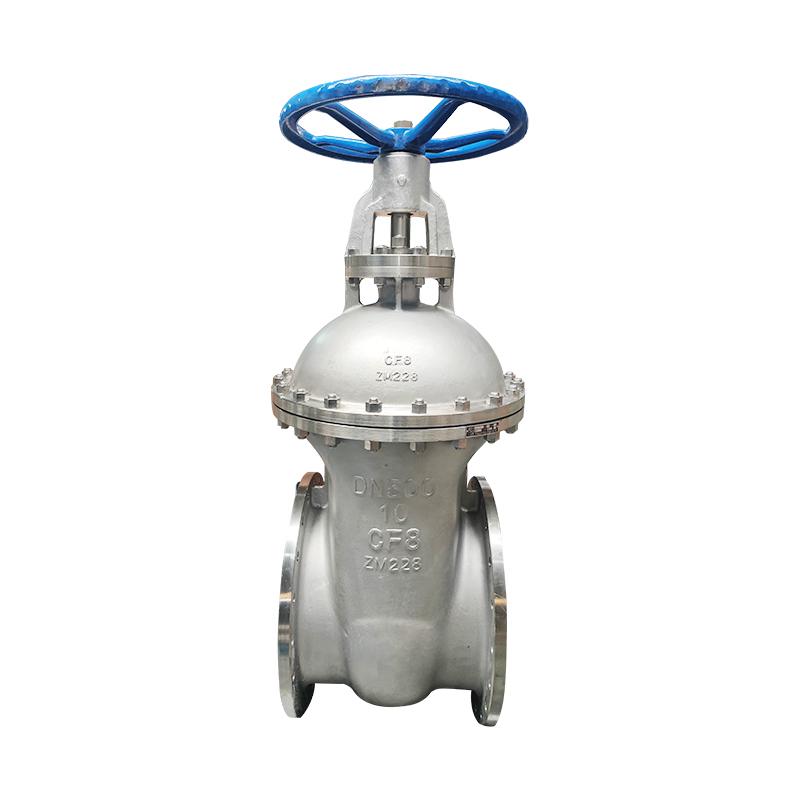
ODM gate valve manufacturing goes far beyond picking a size from a catalog. When a valve has to fit into a cramped pipe gallery or an awkward skid layout, custom geometry becomes the real solution—flange angles, face-to-face dimensions, and body contours can all be adjusted so the valve drops into place without forcing rework elsewhere. The material side matters just as much: specialty alloys and proprietary coatings handle sour gas, abrasive slurries, or seawater exposure that would eat through standard trim in months. Behind that sits a row of precision machining centers built to cut complex internal profiles—angled seats, guided discs, non-standard bores—while holding tight tolerances that preserve flow characteristics and shutoff integrity.
The same workshop can move from a single prototype for a pilot plant to a full production run without changing quality systems, which helps when you need one oddball valve this quarter and three hundred next year. Testing is not a quick hydro pass; multi-stage procedures simulate the actual pipeline, cycling the valve under pressure, temperature swings, and media that mimic field conditions, so surprises show up before installation. And because engineers are directly available during the design phase, questions about seat load, actuator torque, or coating compatibility get answered by the people doing the machining and assembly, not a sales script. That mix of geometry flexibility, material depth, and honest back-and-forth is what separates a true ODM gate valve shop from a reseller with a spec sheet.
Contact Us
Contact Person: Lucas Lin
Email: [email protected]
Tel/WhatsApp: +8613968913000 / +8613868610141
Website: https://www.zhengmaogroup.com