

Professional Angiographic Control Syringe: Essential Features for Precise Contrast Delivery
2026-09-07
In the high-stakes world of interventional cardiology and radiology, every milliliter of contrast media counts. Yet many practitioners overlook a silent factor that can make or break procedural precision: the angiographic control syringe. A poorly designed syringe can lead to inconsistent flow, hand fatigue, or even backflow—subtle issues that compromise imaging quality and patient safety. That's where INT steps in with a professional-grade solution engineered for exact delivery, ergonomic control, and seamless compatibility with modern power injectors. Whether you're navigating tortuous coronaries or mapping complex peripheral vessels, the right syringe isn't just an accessory—it's a critical instrument. In this post, we'll explore the essential features that separate a truly professional angiographic control syringe from ordinary alternatives, and why INT's design deserves a closer look.
Fine Plunger Control for Consistent Contrast Flow
The fine plunger mechanism on this syringe is built around a precision-machined thread that translates even the smallest hand movement into a smooth, predictable advance of the piston. Unlike standard plungers that can stick or surge when you apply variable pressure, this design keeps the contrast agent moving at a steady rate, letting you titrate the flow during delicate vascular procedures without constantly adjusting your grip.
A low-friction seal and a slightly textured thumb rest work together to give you tactile feedback at every point of the stroke. You feel the resistance change early, so subtle adjustments become second nature instead of a reactive struggle. That consistency matters when you need to maintain a controlled column of contrast in a small vessel or when switching between slow fills and rapid flushes during a single injection sequence.
Over time, the plunger retains its smooth action because the internal guide rails are anodized to resist wear and the seal material is chosen to avoid swelling from repeated exposure to iodinated media. This means the same level of fine control on the first use is still there on the fiftieth, helping you rely on muscle memory rather than compensating for a degrading stroke.
Ergonomic Grip That Keeps Hands Steady During Long Procedures
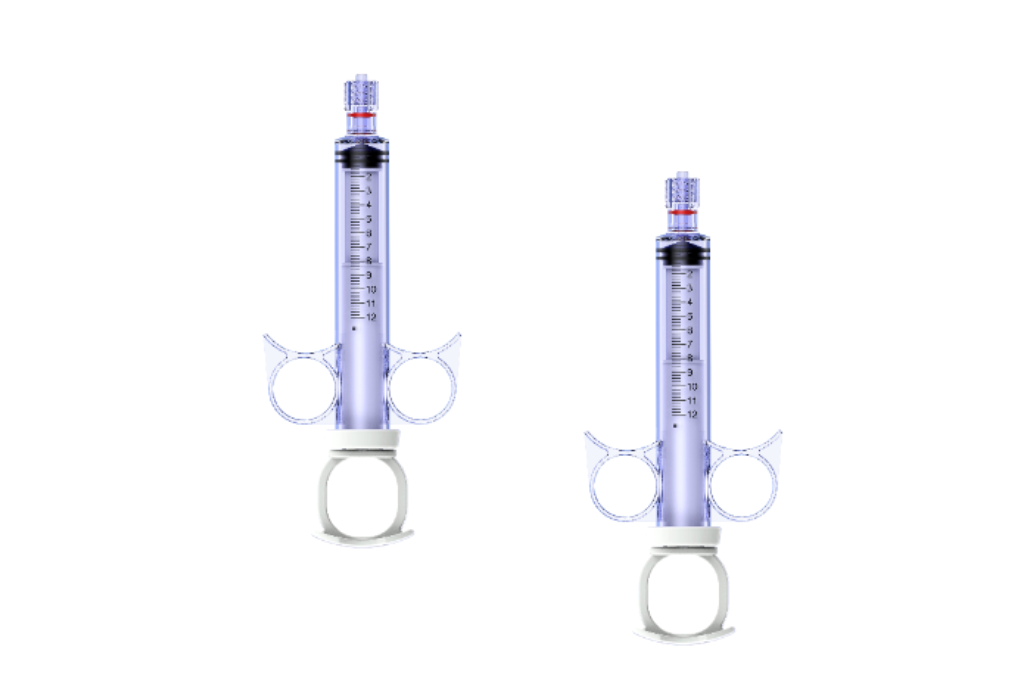
The contour of this grip follows the natural curve of a relaxed palm rather than forcing the hand into a rigid clamp. Pressure settles across the fleshy base of the thumb and the outer heel of the hand, two areas that tire less quickly than the centre of the palm. After a couple of hours, that small shift in load distribution is the difference between a steady hand and one that starts to quiver.
The surface texture is subtle enough to feel smooth at first touch, but it grips damp gloves without turning slippery. A slight give in the material absorbs the tiny tremors that build up from prolonged static holds, so the instrument responds to intention rather than nervous fatigue.
What makes the biggest difference over long procedures, though, is the balance. The weight sits closer to the working end, which means your wrist doesn't have to constantly correct for a handle that wants to tip backward. You stop readjusting your grip every few seconds, and that alone keeps your movements calmer and more precise.
High-Pressure Seal Design to Prevent Backflow and Leakage
Achieving a reliable high-pressure seal involves more than just choosing a tough material. The real challenge is managing the tiny deformation paths that open up under load. Backflow often starts when pressure fluctuations cause the sealing lip to momentarily lift from its seat, allowing a reverse pulse of fluid to creep past. To counter this, designers use asymmetric cross-sections with a steep back angle and a shallow front ramp, so any reverse pressure drives the lip harder into the groove instead of away from it.
Leakage prevention at extreme pressures also depends on surface finish and preload. A polished sealing face with a controlled roughness below 0.2 micrometres Ra reduces micro-channels where fluid can escape. Preloading the seal by 10-15% of its cross-section ensures the elastomer remains in constant contact even as the housing expands under hoop stress. In some high-cycle systems, a secondary O-ring is placed upstream to act as a sacrificial barrier, trapping any backflow before it reaches the primary seal.
Clear Barrel Markings for Instant Volume Verification
Measuring liquid volumes in the field often means squinting at faded graduations or guessing where the meniscus sits. Clear barrel markings solve this by putting bold, high-contrast measurement lines right where your eyes naturally land during a pour. The markings are etched or printed with precision, so you can read the volume at a glance without tilting the container into awkward angles or using a separate measuring cup.
Different materials call for different marking techniques. For chemical-resistant labware, acid-etched graduations stay legible after repeated autoclaving and aggressive solvent exposure. For general-purpose field gear, UV-cured ink printed on the barrel offers sharp contrast against both translucent and opaque plastics. Some designs add a frosted window behind the markings to eliminate glare and refraction, making the meniscus easier to pinpoint even under direct sunlight or in dimly lit storage rooms.
Instant verification means fewer errors and less waste. When every barrel shows the exact fill level from across the bench or down the row of a shelf, you can batch-check inventory in seconds instead of walking each container to a light source. The clarity of the markings also reduces the temptation to overfill or underfill, which matters when dosing reagents, mixing fuels, or portioning out concentrates. In practice, a well-marked barrel turns volume checking from a careful task into a quick glance.
Matching Syringe Volume to the Demands of Each Angiogram
Choosing the right syringe volume for an angiogram is not a one-size-fits-all decision. Coronary studies, for instance, often require precise, small-volume injections to avoid overloading a single vessel, while peripheral runoff imaging may demand larger, sustained volumes to track contrast through long vascular territories. The operator must weigh catheter size, vessel caliber, and the specific phase of the study to prevent hand fatigue and maintain steady injection pressure.
A 10 mL syringe might be ideal for selective renal or mesenteric injections where quick, controlled boluses matter more than total volume, whereas a 20 mL or larger syringe suits aortography or lower-extremity runs where continuous flow and higher total contrast delivery are essential. Using an oversized syringe for a delicate intracranial injection can reduce tactile feedback and increase the risk of vessel damage, while an undersized one forces refills mid-procedure and breaks the imaging sequence.
Practically, many labs standardize on 12 mL or 20 mL syringes with power injectors for high-flow arterial studies, but manual injections still benefit from matching syringe size to the expected volume and flow rate. The goal is to keep the injection smooth, avoid air traps from repeated filling, and ensure the contrast arrives at the target vessel with enough momentum to produce a diagnostic-quality image without unnecessary patient dose or contrast load.
Sterilization and Material Choices That Protect Contrast Integrity
Maintaining contrast integrity starts with recognizing that common terminal sterilization methods can trigger subtle chemical shifts in iodine-based or gadolinium-based agents. Autoclaving, for instance, exposes the formulation to saturated steam at 121°C or higher, which may accelerate hydrolytic breakdown of certain chelates or cause dimerization in non-ionic dimers. Gamma irradiation, while effective at lower temperatures, generates free radicals that can attack the aromatic rings of contrast molecules, leading to free iodine release and pH drift. Even e-beam sterilization, with its shorter exposure time, demands careful dose mapping because localized energy deposition can create hot spots within the bulk solution. Each method must be paired with a stability-indicating assay that tracks not just active ingredient concentration but also degradation byproducts, osmolality, and particulate load before release.
Material selection becomes the second line of defense. Contrast media are often filled in polymer syringes or vials, and the container must not leach ions, plasticizers, or slip agents that could catalyze degradation or form visible particles. Cyclic olefin polymers (COP/COC) have gained favor because their low extractable profile and high moisture barrier protect hydrolytically sensitive agents better than polypropylene or polycarbonate. Glass, especially Type I borosilicate, remains the reference for long-term storage but requires siliconization for syringe plunger movement. The silicone oil layer, if applied unevenly, can emulsify with the contrast agent and reduce optical clarity. Fluoropolymer-coated stoppers and plungers, along with minimized silicone levels, help preserve both chemical purity and visual inspection quality. Laminated films for overwrap also play a role by controlling oxygen ingress and preventing light-induced oxidation of the active molecule.
Beyond bulk container materials, every component that contacts the contrast agent—needle adhesives, elastomer seals, and even residual sterilization gases—must pass a compatibility screen under worst-case conditions. Ethylene oxide, for example, can alkylate amine groups in some contrast formulations, so residual EO and its byproducts must be tightly limited. Extractables and leachables studies under accelerated aging conditions reveal whether any substance from the packaging migrates into the drug product and triggers color change, precipitation, or loss of signal intensity. A robust material strategy also includes process controls: washing steps that remove mold release agents, drying cycles that prevent moisture condensation inside the barrel, and visual inspection systems trained to reject units with fiber, gel, or crystalline contamination. When sterilization and material choices are engineered together, the contrast agent reaches the patient with its molecular structure, pH, and osmolality unchanged, ensuring reliable imaging performance without safety surprises.
FAQ
It is built for one-hand operation and precise flow control. A thumb ring, short plunger travel, and low-resistance seal let the operator inject contrast steadily in the cath lab while reducing hand strain.
Contrast flow rate and volume directly affect image quality and patient safety. Injecting too fast can stress the vessel, while too slow an injection may not opacify the target area, so the syringe has to allow fine adjustments in real time.
A transparent barrel, a clear venting path, and a secure Luer connection make bubbles easier to see and remove. Some designs also include a one-way valve or a hydrophilic coating that keeps air from clinging to the inner wall.
High-clarity material lets the operator see the contrast level, color, and any trapped air, making it possible to fully purge the line before connecting to the catheter and avoid pushing air into the vessel.
Professional models are typically rated for the pressures used in angiography, though the exact limit depends on the barrel and seal construction. They are often paired with power injectors or manual assist devices to maintain a steady flow without rupture.
A textured or ringed plunger handle gives a more reliable grip, and the low-friction seal keeps forward and backward movement smooth. It also holds position when you stop, which helps prevent accidental over-injection.
Most use a standard Luer fitting and connect to common catheters and tubing. For contrast compatibility, the barrel and plunger materials are generally inert to iodinated and gadolinium-based agents.
They are usually single-use sterile devices and should be discarded as sharps or infectious waste after the procedure. Reuse or resterilization is not recommended because residual contrast and high-pressure stress can compromise safety.
Conclusion
Achieving consistent contrast delivery in angiography starts with how the syringe responds to the clinician's hand. A finely controlled plunger lets you adjust flow rates without sudden surges or drop-offs, which matters when imaging small vessels or dealing with fragile access sites. The grip itself is shaped to reduce hand fatigue during lengthy cases, so the steady hold you need at hour one doesn't fade by hour three. Under pressure, the seal between plunger and barrel has to hold. A high-pressure design prevents contrast from leaking backward or air from being drawn in, keeping every injection predictable and clean.
Clear barrel markings make it possible to confirm the exact volume at a glance, which helps when you have to reconcile the amount drawn, injected, and remaining without second-guessing. Different angiograms call for different volumes, and having a syringe that matches the procedure's demands avoids both underfilling and wasteful overdraw. Behind all of this, the material and sterilization choices determine whether the contrast remains stable and uncontaminated. When the syringe body and seals are made from materials that don't interact with the contrast media, and the sterilization process preserves those properties, you get reliable performance that protects both the image quality and the patient.
Contact Us
Contact Person: Jeffrey
Email: [email protected]
Tel/WhatsApp: 86-0633-2230056
Website: https://www.sd-intmedical.com