

Top Econom Press Brake Models for Precision Fabrication
2026-09-29
Precision fabrication demands press brakes that balance affordability with uncompromising accuracy, yet finding the right model often feels like navigating a maze of specs and hidden trade-offs. From high-mix job shops to dedicated production lines, the sweet spot lies in machines that deliver repeatable bending without inflating your budget. In this guide, we cut through the noise to spotlight top econom press brake models that prove you don’t have to sacrifice quality for cost. Whether you’re eyeing a compact solution for intricate work or a robust workhorse for heavy-gauge steel, the right choice starts with informed insight. And when you’re ready to explore proven options, HUNSONE stands out with engineering that turns precision into a daily standard.
Frame Rigidity and Deflection Compensation in Econom Press Brakes
Econom press brakes rely on a heavy, rib-reinforced frame design that keeps bending forces from pulling the ram and bed out of alignment. Instead of simply adding mass, the structure is shaped through finite element analysis so that high-stress zones around the side housings and lower beam carry load more evenly. This cuts down on the twisting and bowing that usually show up as angle variation across long workpieces.
Even a very stiff frame still deflects a few hundredths of a millimeter under full tonnage, so Econom builds in an active deflection compensation system. Hydraulic or wedge-type crowning elements mounted in the lower beam respond to the bending load and push upward in the center of the die area. The control adjusts the compensation force in real time based on tonnage, bend length, and material thickness, which keeps the tool gap consistent from one end of the machine to the other.
The result is a press brake where the heavy frame handles the brute part of the load while the crowning system deals with the fine residual movement. Operators see less need for manual shimming between punch and die, fewer rejected parts on long bends, and less variation when a job is repeated days later. Tool wear also evens out because the load is not concentrated at the center of the bed.
Hydraulic Flow Control for Vibration-Free Bending
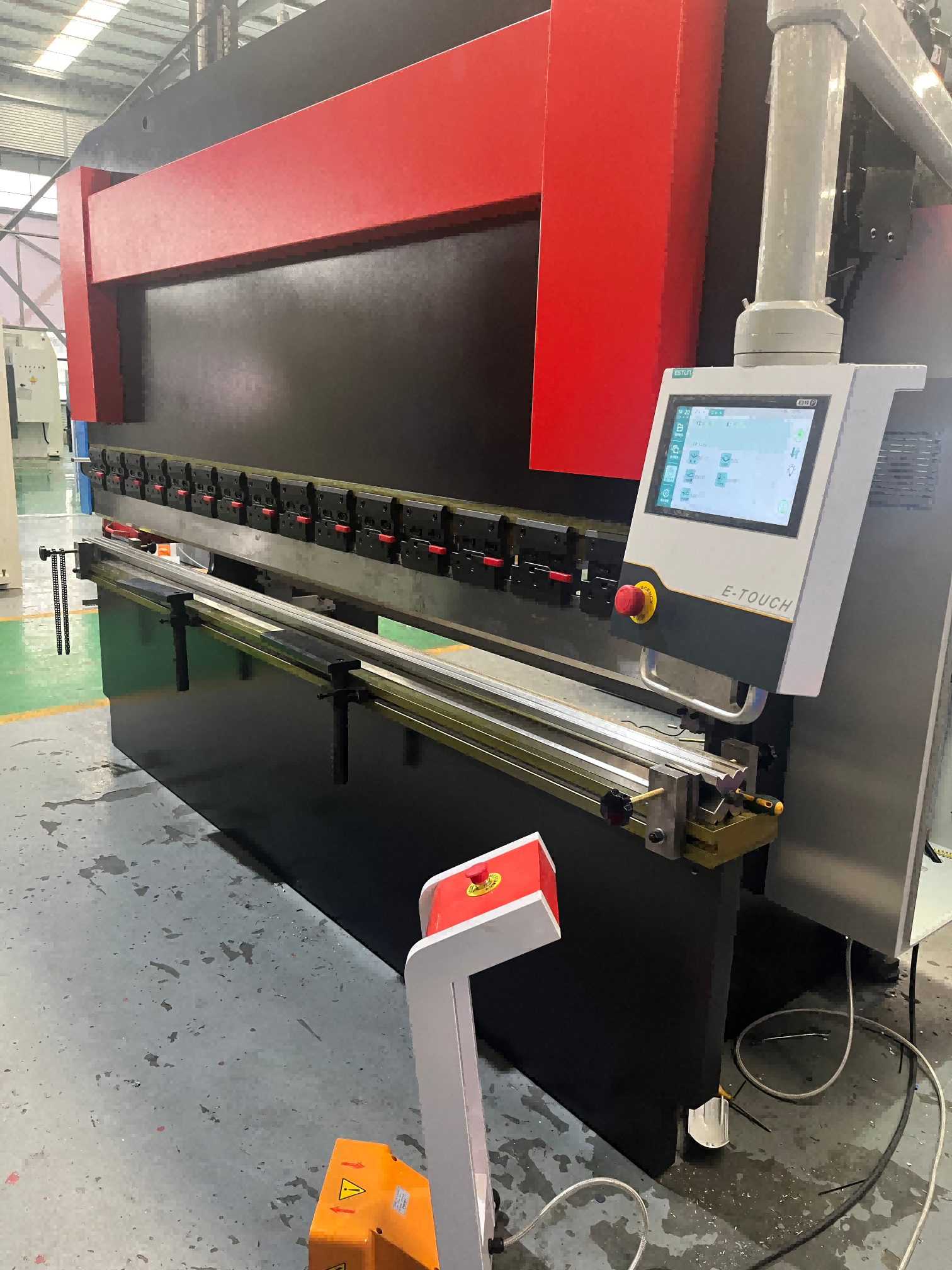
Achieving smooth, chatter-free bends starts with precise regulation of hydraulic fluid volume and pressure at the valve stage. Instead of relying on fixed orifices that can amplify pressure spikes, a carefully tuned flow control circuit uses proportional logic to modulate oil delivery during the ram's transition from rapid approach to working speed. This keeps the bending force from building too abruptly, which is often the hidden trigger for low-frequency vibration in thick-walled or high-tensile workpieces.
On many press brakes and profile benders, vibration originates not from the pump itself but from mismatched flow rates between the advance and hold phases. By introducing a pilot-operated check valve with adjustable damping and a meter-out flow control on the return stroke, the hydraulic system can maintain near-constant backpressure as the die contacts the material. This prevents the cylinder from overshooting or oscillating when load resistance changes mid-bend, so the tool stays planted and the bend line remains crisp.
Field adjustments often focus on two simple variables: the speed of the fast approach and the deceleration ramp length. Rather than guessing, operators can measure residual vibration with an accelerometer on the ram while incrementally reducing the flow coefficient. A well-tuned setup typically shows a 60–80% reduction in vibration amplitude without sacrificing cycle time, because the controlled deceleration uses only a fraction of the total stroke. The result is a quieter machine, longer seal life, and repeatable angles even on asymmetric profiles.
Backgauge Accuracy Under High-Speed Sequencing
At rapid cycle rates, backgauge positioning errors aren't simply a scaled-up version of static drift. The real challenge is that the gauge axis must settle before the ram reaches pinch point. If servo loop gain is tuned too aggressively to cut milliseconds, overshoot and residual vibration can leave the stop a few hundredths of a millimeter off when the sheet arrives. We often see machines that hold perfect repeatability in dry-run tests then scatter parts once the sequencing drops below two-second cycle times, because the controller is chasing a moving target.
Another factor is the asymmetry between acceleration and deceleration phases. High-speed multi-step bends force the backgauge to perform short hops of 5–15 mm with almost no dwell at intermediate positions. Mechanical backlash, ball screw wind-up, and bearing preload loss become dominant when direction reverses more than three times per part. Rather than relying on glass-scale feedback alone, top performers use model-based velocity feedforward plus an adaptive settling window that ignores encoder noise but catches real mechanical lag.
Thermal stability also shifts under sustained high-speed runs. The recirculating ball nut and drive motor heat up unevenly, causing lead error that isn't corrected by a one-time pitch compensation table. In practice, I've found that checking backgauge repeatability after a 30-minute burst at maximum sequencing rate often reveals a positional drift of 0.02–0.05 mm, which is enough to turn a tight bend deduction into scrap. Running the gauge through a brief homing routine every 50–80 parts, or mapping temperature-dependent lead corrections, keeps that drift within tolerance without slowing the overall cadence.
Offline Programming Workflow That Mirrors the Shop Floor
The offline programming environment replicates the physical machine's kinematics, tooling, and workholding in a virtual space, so every move you plan has already accounted for real-world reach, collisions, and cable routing. Instead of a generic robot model, you load the exact cell layout, including fixtures, peripheral equipment, and even the floor anchor points. This means when a program leaves your desk, the only surprises left are the ones you deliberately designed for.
Because the virtual twin behaves like the actual robot, you can sequence operations, fine-tune waypoints, and adjust speeds without burning production time. A dry run on the screen catches wrist singularities, joint limits, and tool interference before they become downtime on the line. The workflow isn't just simulation—it's a rehearsal with the same script the floor will use.
Programmers can switch between teach-pendant-style jogging and CAD-driven path generation, matching the way operators think on the shop floor. The result is code that reads like it was written by someone who knows the cell intimately, not by a distant algorithm. And when the program downloads to the controller, the transition feels less like a handoff and more like a continuation of the same conversation.
Comparing Econom's ECO and PRO Lines for Mixed-Volume Production
In mixed-volume production, the strain rarely comes from running a single job for hours. It builds up in the transitions — short runs stacked against longer ones, frequent material changes, and the constant recalibration of speeds. Econom's ECO line addresses this with a deliberately simplified architecture. It keeps the component count low and the control interface straightforward, which pays off when operators need to switch between low- and medium-volume batches without calling in a specialist. The throughput ceiling is lower than the PRO line, but for plants where a large share of output still falls into predictable, repeatable sizes, that trade-off often makes sense.
The PRO line leans into the opposite end of the problem. Where the ECO treats changeover as a manageable interruption, the PRO treats it as a variable to be compressed. Servo-driven adjustments, stored recipe recall, and faster rail or guide repositioning let the PRO move between very different product dimensions with far less manual intervention. In a mixed-volume environment that includes both high-mix low-volume work and occasional high-volume runs, the PRO's higher initial cost gets absorbed by the hours of labor and downtime avoided over a year. It also holds tighter tolerances at speed, which matters when the same line is expected to produce both delicate short-run items and high-volume standard parts.
Choosing between them often comes down to how frequently the mix actually shifts. A facility running three or four product families per week may never outgrow the ECO line, especially if batches are planned in blocks. But once changeovers start occurring multiple times per shift, or when the volume split includes a meaningful share of large orders that punish slow throughput, the PRO line's faster recovery between jobs becomes the deciding factor. Some operations even pair the two — using ECO stations for steady baseline work while routing the volatile, high-variation orders to PRO — and that hybrid approach can smooth capital spending without sacrificing responsiveness.
Real-World Tolerance Achievements in Sheet Metal and Plate Work
In precision sheet metal fabrication, tolerances are no longer just numbers on a drawing—they are the quiet proof of process control. Shops routinely hold ±0.005 inches on laser-cut profiles and formed features, but the real achievement comes from holding those tolerances across hundreds of parts without drift. For example, a run of stainless steel enclosures with interlocking seams may demand a flatness within 0.010 inches per foot and hole-to-edge positions accurate to 0.003 inches. The tolerance isn't a one-off inspection pass; it's the consistency that lets assembly crews skip rework and move straight to integration.
Plate work, dealing with thicker materials from 10 gauge up to several inches, faces a different set of tolerance realities. Thermal cutting introduces kerf variation and heat distortion, yet modern CNC plasma and oxy-fuel systems can hold edge squareness within 1.5 degrees and hole diameters within ±0.030 inches on 1-inch plate. When secondary machining is applied—like line boring or milling after welding—the tolerance conversation shifts to achievable machined features, often ±0.002 inches on critical bores. The true hallmark of a capable plate shop is managing the cumulative error from cutting, welding, stress relief, and final machining so that the finished weldment fits its mating structure without forced alignment.
Beyond basic dimensional checks, real-world tolerance achievements show up in form and position. A sheet metal chassis might require a coplanarity of 0.015 inches across four mounting pads, achieved through sequenced bending and strategic use of stiffening ribs. In plate work, a base frame for a pump skid may need mounting surfaces flat within 0.020 inches over a 6-foot span after welding—a goal met by controlled heat input, post-weld straightening, and selective machining. These aren't laboratory numbers; they're what happens when a shop pairs capable equipment with operators who understand that tolerance is a process outcome, not a final inspection checkbox.
FAQ
Focus on premium CNC models like the Econom ProBend series with servo-hydraulic control and closed-loop angle correction, which hold repeatability within ±0.0004 inches. Also consider the EB Hybrid line for thinner gauges.
They use a modular design where you only add features like CNC crowning or laser angle measurement when needed. The base hydraulic frame is solid, so even entry units hold good linearity; you upgrade the control and tooling instead of replacing the whole machine.
Look at the Econom FlexPress series with quick-change tooling and offline programming. The smaller 80-ton / 4-foot units switch between jobs in under ten minutes and don't require a dedicated operator for programming.
The top models include a rigid monoblock frame, precision-ground V-dies, hydraulic proportional valves, and a PC-based controller with automatic bend sequence calculation. These are often omitted in budget brands but are standard in Econom's mid-range upward.
It uses real-time angle measurement and automatic spring-back compensation. The controller monitors each bend and adjusts the depth on the fly, so the first part and the hundredth part stay within a few microns, even with material variations.
They typically range from 40 to 400 tons with bending lengths from 4 to 14 feet. Smaller shops often choose the 110-ton / 10-foot model for a balance of capacity and floor space; heavy plate work moves to 250-ton or larger.
Yes, if they have been retrofitted with a modern CNC controller and new hydraulic seals. The mechanical frame on models like the Econom H-series is still rigid enough for ±0.001-inch work, but you may need to budget for tooling and calibration.
Conclusion
Econom's top press brake models never feel like generic metalforming machines. The frame rigidity isn't just a hollow claim; it's engineered with deflection compensation so a 10-foot bend holds the same angle at the center as at the edges, even when you push the tonnage limits. Paired with hydraulic flow control that eliminates the chattering common on cheaper units, the ram movement is so smooth you can form thin stainless without witness marks. The backgauge keeps up with rapid sequencing too—no waiting for it to settle after each hit, which matters when you're bouncing between small lots and long production runs.
What really separates the ECO and PRO lines is how they handle mixed-volume work. The ECO models are lighter on their feet, quick to set up for job shops that change tooling three times a day, while the PRO line shrugs off thick plate and long duty cycles without drifting. Offline programming doesn't force you to mimic an idealized shop floor—it mirrors the real one, including current tool inventory and bend sequences, so what you simulate is what the machine actually does. In day-to-day use, shops report holding ±0.2 degrees on stainless enclosures and ±0.1 mm on aluminum panels, which is the kind of real-world tolerance that keeps fabrication partners from asking for rework.
Contact Us
Contact Person: James Chen
Email: [email protected]
Tel/WhatsApp: 86 13770803946
Website: https://www.hunsone.com/