

Water-Absorbent Expansion Bag Company Reveals Top Applications for Rapid Water Control
2026-11-16
When floodwaters rise unexpectedly, every second counts. Standard sandbags often fall short—heavy, slow to deploy, and easily compromised. That's why Jianghe Flood Prevention is drawing attention to the most effective ways to use water-absorbent expansion bags for rapid water control. From protecting doorways and underground garages to diverting storm runoff around critical infrastructure, these compact barriers activate in minutes and swell into reliable flood defenses. In this post, we explore the top applications that emergency responders, facility managers, and homeowners are turning to—and why this approach is changing how we think about fast, flexible flood response.
When Floodwaters Rise, a Bag That Swells Becomes the First Line of Defense
Unlike traditional sandbags that demand heavy lifting and time you rarely have, these bags stay compact until they touch water. Within minutes of soaking, the polymer filling expands into a firm, interlocking barrier that digs into uneven ground and redirects the flow away from doorways, garages, and basement entries.
The real advantage shows up before the storm does. A single person can carry a dozen flat-packed bags to the place they're needed, stack them dry, and let the rising water do the activation work. There's no sand to source, no shovel, and no sore back—just a dense wall that forms exactly where the first breach would otherwise happen.
When the threat passes, the bag shrinks as it dries and can be reused for the next weather event. For anyone who has watched water creep toward a threshold at 2 a.m., that combination of speed, portability, and second-use resilience is what makes a swelling bag more than a temporary fix.
Industrial Spill Control Without Pumps or Power
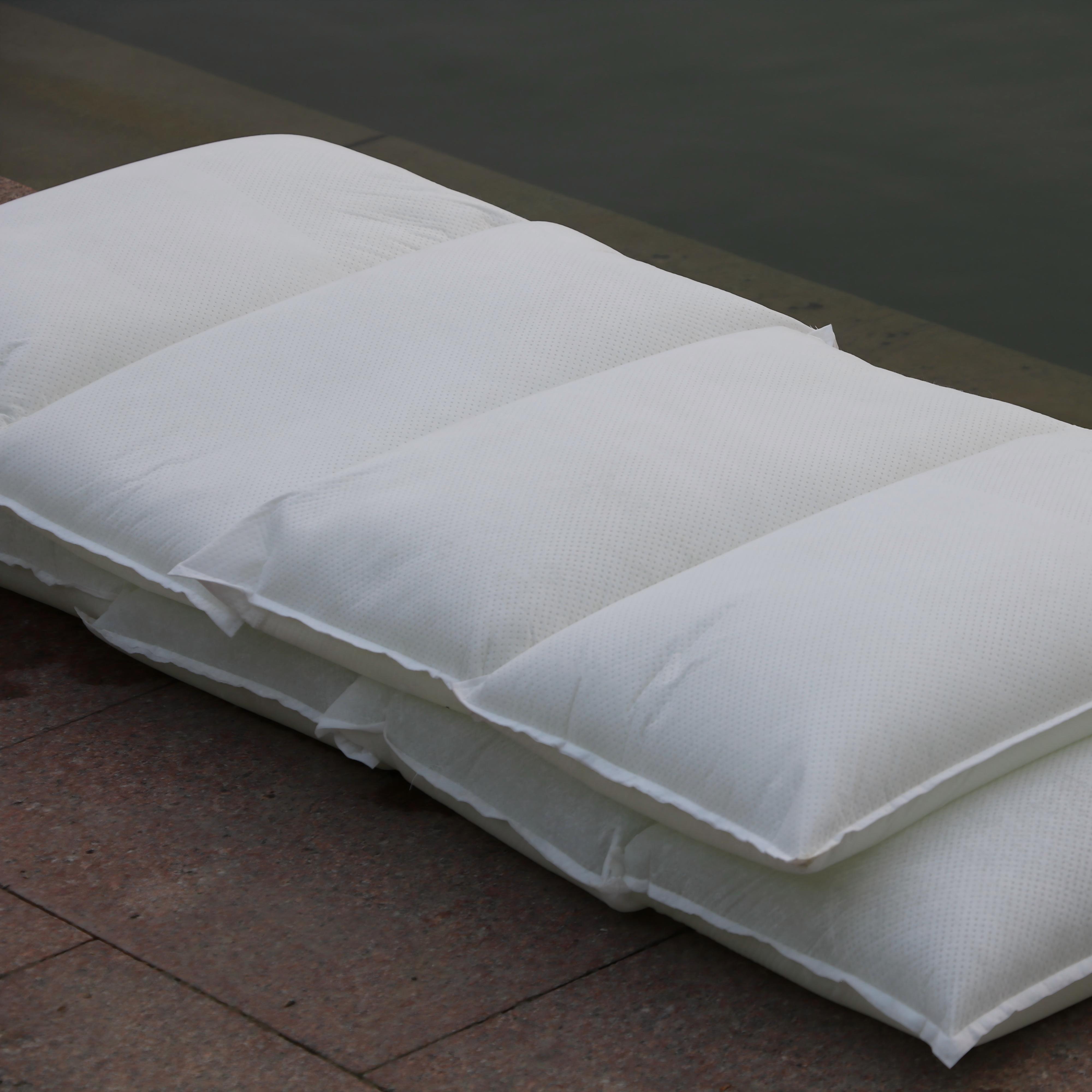
Spill response in industrial settings usually brings to mind electric pumps, vacuum trucks, and portable generators. But there are plenty of situations where none of that is available—remote storage yards, rail sidings, temporary job sites, or areas hit by power loss. In these cases, the first line of defense is almost always passive containment. Drain covers, berms, and spill decks can be placed or unfolded by hand. They work by using gravity and the natural shape of the ground to keep liquid from reaching storm drains or soil. A flexible polyurethane drain seal, for example, simply lies over the grate and seals when liquid presses down on it. No motor, no switch, no moving parts.
Absorbents also do a lot of quiet work without any power source. Meltblown polypropylene pads, socks, and booms are designed to soak up oils, coolants, and solvents while leaving water behind. A worker can toss them into a pooling spill or ring them around a leaking drum. The trick is to match the absorbent to the liquid—hydrophobic pads for oil on water, universal sorbents for mixed chemicals. Because the material is lightweight and easy to cut, one person can handle a fairly large release simply by layering pads and then sweeping up the saturated material into disposal bags.
Gravity can also be turned into a low-tech transfer method. A simple siphon made from food-grade hose can move liquid from a leaking container into a lower-placed drum, as long as the destination sits below the source. This is especially useful for slow drips or small-volume spills where a pump would be overkill. Combined with wedges, shims, and drip pans, these manual tools let a crew stop the spread, recover the liquid, and stage it for proper disposal without relying on a single watt of electricity.
Keeping Excavations and Trench Work Dry in Any Weather
Heavy rain can turn an open trench into a hazard in minutes, so the first rule is managing water before it accumulates. A well-placed sump pump at the lowest point paired with a perforated collection pipe keeps the base firm enough for pipe laying or footing work. For sandy or silty soils, a single pump rarely keeps up; you may need a wellpoint system or a deep well dewatering setup that draws the water table down below the excavation floor. The exact method depends on soil permeability and trench depth, but walking the site after a rainstorm often reveals where water ponds and where extra drainage is needed.
Surface water is easier to handle than groundwater, but only if you plan for it. Slope the ground away from the trench edges, and use temporary berms or sandbags to divert runoff before it reaches the cut. A heavy-duty plastic sheet over stockpiled soil and the trench face itself can stop rainwater from saturating the sides, which reduces sloughing and keeps the crew from fighting mud all day. When a sudden storm hits, covering the excavation and clearing pump intakes of debris can be the difference between losing an hour and losing a whole shift.
In freezing weather or prolonged wet spells, don't overlook the effect of repeated wet-dry cycles on trench stability. Water that seeps into fissures and then freezes expands, loosening the walls even when the trench looks dry. Check the edges each morning before anyone enters, and be ready to switch from a passive drainage approach to active dewatering if the weather forecast trends worse. A dry trench isn't just about comfort; it keeps the bedding material from washing out and prevents the kind of soft-bottom failures that lead to rework.
Underground Parking and Subway Entrances Stay Dry Without Electricity
Urban infrastructure often depends on continuous power for drainage, but many underground parking facilities and subway entrances manage to remain dry even during blackouts. This resilience stems from passive design choices that work with gravity and natural water flow. Sloped entry ramps, raised thresholds, and strategically placed drainage channels direct rainwater away from openings, while permeable surfaces nearby allow water to soak into the ground rather than pool at doorways.
Materials also play a critical role. Porous concrete and gravel-filled trenches act as silent workhorses, capturing and slowly releasing water without any mechanical pumps. In some cases, underground spaces are built slightly above the surrounding street level, creating a natural barrier that keeps surface runoff from entering. These measures require little to no maintenance and continue to function long after backup generators might fail.
Even in regions with heavy rainfall, simple innovations like catchment basins hidden beneath landscaping or oversized storm drains positioned away from entrances prove effective. By designing with the assumption that power may not always be available, engineers create spaces that stay dry through thoughtful geometry and material choice rather than reliance on electric sump pumps. The result is safer, more dependable access during extreme weather events and unexpected outages.
Farm Runoff and Irrigation Water: Holding Back the Flow Where It Starts
Most runoff doesn't begin as a rushing stream at the field's edge. It starts in small pockets where rain or irrigation water outpaces the soil's ability to soak it in. Once that thin sheet of water starts moving, it picks up loose soil, fertilizer, and pesticides. The most effective fix is to slow it down right there—before it ever leaves the field. Simple changes to field layout and soil structure can make the difference.
Contour farming on sloped ground turns each row into a tiny dam that interrupts downhill flow. Cover crops between cash crop seasons keep roots in the soil, which opens up channels for water to infiltrate instead of ponding and running off. On the irrigation side, switching from flood or fixed sprinklers to drip tape or surge valves applies water only where and when the crop needs it, leaving very little excess to escape.
Farmers who adopt these source-level practices often notice something beyond cleaner ditches: lower water bills, healthier root zones, and less topsoil lost to each storm. Over a few seasons, the soil itself becomes more absorbent, which means future rains are less likely to trigger runoff at all. That is the real payoff—stopping the flow where it starts builds a farm that holds onto water instead of fighting it downstream.
Temporary Dams and Diversions: Rerouting Water on Short Notice
When a culvert fails or a stream suddenly jumps its banks, there is rarely time for drawn-out engineering reviews. Temporary dams and diversion channels step into that gap. They are not meant to be permanent; they buy hours or days so crews can work in the dry, protect downstream properties, or simply keep a road open. The best designs are almost crude in their simplicity: sandbags stacked in a herringbone pattern, sheet piling driven by a vibrating hammer, an inflatable bladder pumped full of river water. Each one redirects flow without pretending to tame it.
Choosing a method depends less on hydrology textbooks and more on what is lying around the yard. A highway maintenance depot might have a few hundred feet of water-filled barrier and a loader that can drop riprap faster than a crane. A rural contractor might rely on a dozer blade and a pile of clay. In all cases, the goal is the same: create a low point where water should go, and a high point where it should not. Often that means cutting a pilot channel with an excavator while building a plug across the old alignment. If the plug leaks, it is not a failure—it is a signal to add another layer.
The real skill is knowing when to pull the temporary works out. Left too long, a diversion can scour its own banks, undercut a bridge pier, or become the new permanent channel against everyone’s wishes. Experienced crews watch for telltale signs: a sandbag wall starting to slump, a turbid plume downstream that grows darker by the hour, the sound of gravel rolling in the current. At that point, the only acceptable move is to open the original path gradually, letting the river settle back into its old habits before the temporary dam is removed piece by piece.
FAQ
Low-lying building entrances and underground garages are the usual first targets—one or two bags can seal a doorway well before sandbag walls become practical.
Yes, the material keeps absorbing and swelling as water levels climb, so the barrier grows tighter instead of washing away like loose fill alternatives.
They arrive flat and lightweight, so a single pickup can carry hundreds; on site, you just place them dry and let the water trigger expansion, cutting setup time dramatically.
Pipe galleries, vaults, and transformer rooms often use them around cable entries and door sills, where a quick water stop prevents shutdowns without needing heavy equipment.
People typically lay them across window wells and the base of exterior stairs before heavy rain, creating a soft dam that swells into gaps and blocks seepage.
They conform to the ground as they expand, pressing into depressions and around gravel, which gives a tighter seal than rigid barriers on irregular surfaces.
Store them dry in a sealed container or vehicle compartment; no pre-soaking or filling is needed, and they stay ready until water exposure triggers the reaction.
Most are single-use by design because the absorbed water and contaminants make drying impractical, but the spent material can be disposed of with normal waste in many areas.
Conclusion
When floodwaters climb faster than sandbags can be stacked, a water-absorbent expansion bag changes the equation. These bags, filled with a superabsorbent polymer, swell into a firm barrier within minutes of touching water. On streets and doorsteps, they become the immediate first line of defense, holding back surge without the need for heavy machinery or extra labor. The same principle works in industrial settings: a chemical or fuel spill can be encircled and contained before it spreads, no pumps or electrical power required. Contractors also rely on them to keep excavations and trenches dry. Rain, groundwater, or a burst pipe near a digging site gets trapped by the expanding material, letting work continue in any weather instead of waiting for conditions to improve.
Underground parking garages and subway entrances pose a unique challenge because they sit below grade and often lack backup power for electric pumps. Expansion bags slide neatly across doorways and ramp edges, swelling to seal gaps when water approaches. In agricultural areas, the bags are placed at the edges of fields or along irrigation channels to slow runoff and stop nutrient-laden water from moving downstream. For emergency managers, the same bags can be linked or stacked into temporary dams and diversions, rerouting water on short notice around critical infrastructure or away from vulnerable neighborhoods. Each use case shares a single advantage: rapid, manual deployment that works without pumps, hoses, or power, turning a lightweight sack into a reliable water-control tool exactly when and where it is needed.
Contact Us
Contact Person: Kristin Zhang
Email: [email protected]
Tel/WhatsApp: +8615366239752
Website: https://www.jianghecn.com/